
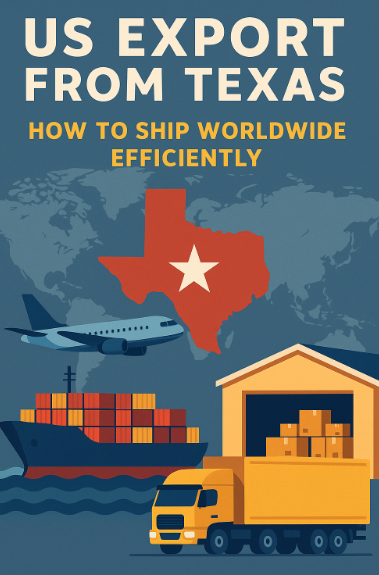
Texas is not just the heart of American energy; it’s also a key engine of the U.S. export economy. From oil and electronics to machinery and agricultural products, US export from Texas fuels industries around the globe. The state’s advanced logistics infrastructure, extensive trade routes, and port accessibility make it one of the most strategic locations for international shipping.
In this comprehensive guide, you’ll learn how to manage exports from Texas effectively — including trade data, logistics strategies, customs requirements, and how Velotac Logistics helps exporters ship worldwide efficiently.

Why Is Texas a Powerhouse in US Exports?
Texas has ranked as the number one U.S. exporting state for over two decades. Its location, bordering Mexico and the Gulf of Mexico, provides unmatched access to both land and sea trade routes. In 2024, Texas exported goods worth over $480 billion, accounting for nearly 25% of total U.S. exports.
Top export destinations include Mexico, Canada, China, South Korea, and Brazil. The energy sector continues to dominate, but technology, manufacturing, and agriculture are growing rapidly, diversifying the state’s export profile.
Therefore, whether you’re shipping petroleum, semiconductors, or livestock feed, Texas offers a global gateway for every industry.
What Are the Top Exports from Texas?
Texas exports span multiple industries, making it one of the most diversified trade economies in the world.
| Product Category | 2024 Export Value (USD Billion) | Major Destinations |
|---|---|---|
| Petroleum & Natural Gas | 180 | Mexico, Netherlands, Japan |
| Chemicals & Plastics | 62 | Canada, China, Germany |
| Computers & Electronics | 54 | Mexico, Singapore, South Korea |
| Machinery & Equipment | 46 | Brazil, India, UK |
| Agricultural Goods | 32 | China, Vietnam, Canada |
| Vehicles & Auto Parts | 24 | Mexico, Chile, Saudi Arabia |
Texas’s dominance in energy exports is complemented by its strong performance in advanced manufacturing, making it a global export leader.
Which Texas Ports Handle Most Export Activity?
Texas offers a powerful network of deep-water seaports, international airports, and border crossings, connecting exporters to every region worldwide.
| Port / Hub | Type | Strengths |
|---|---|---|
| Port of Houston | Seaport | Largest Gulf Coast port; ideal for petrochemicals and containers |
| Port of Corpus Christi | Seaport | Major crude oil export terminal with deep-water access |
| Port of Galveston | Seaport | Handles bulk, breakbulk, and automotive cargo |
| Dallas/Fort Worth (DFW) Airport | Air Cargo | Fast air freight connections to Asia and Europe |
| Houston (IAH) Airport | Air Cargo | Supports temperature-sensitive and high-value shipments |
| Laredo Border Crossing | Land | Key route for U.S.–Mexico truck freight |
With these infrastructure advantages, exporters can efficiently reach global destinations with predictable transit times and lower freight costs.
What Are the Common Shipping Methods for Texas Exports?
Selecting the right shipping method is essential for balancing cost, speed, and cargo safety.
| Mode | Average Transit Time | Cost Level | Ideal Cargo Type | Key Advantages |
|---|---|---|---|---|
| Sea Freight | 20–40 days | Low | Bulk commodities, machinery | Cost-effective for large volumes |
| Air Freight | 2–7 days | High | Electronics, urgent goods | Fastest and most secure option |
| Truck Freight | 1–5 days | Medium | Exports to Mexico or Canada | Efficient cross-border shipping |
| Rail Freight | 5–10 days | Moderate | Industrial and intermodal cargo | Environmentally friendly and stable |
Therefore, exporters should choose modes based on cargo type and urgency. Velotac Logistics helps optimize routes by combining multimodal shipping to reduce both transit time and costs.
How Does the Export Process Work in Texas?
Exporting from Texas involves several critical steps. Each must be carefully managed to ensure compliance and avoid costly delays.
- Product Classification: Assign the correct HS (Harmonized System) code.
- License Determination: Check if your goods require an export license.
- Carrier Booking: Choose the right shipping method and schedule.
- Documentation Preparation: Complete invoices, packing lists, and certificates.
- Customs Filing: Submit export declarations via AES (Automated Export System).
- Shipment Execution: Move goods to the port or airport for carrier handling.
- Destination Clearance: Ensure customs compliance in the importing country.
Velotac Logistics provides end-to-end management of this process, from document preparation to customs coordination, allowing Texas exporters to focus on business growth.
What Export Documents Are Required in the US?
Proper documentation ensures seamless customs clearance and protects your shipments from delays.
| Document | Purpose | Issued By |
|---|---|---|
| Commercial Invoice | Details sale, value, and buyer info | Exporter |
| Packing List | Lists cargo contents and dimensions | Exporter |
| Bill of Lading / Air Waybill | Transport record and proof of shipment | Carrier |
| Certificate of Origin | Verifies product’s manufacturing country | Chamber of Commerce |
| Shipper’s Export Declaration (SED) | Filed for goods over $2,500 | Exporter or broker |
| Insurance Certificate | Confirms cargo coverage | Insurance provider |
By verifying these documents before shipment, exporters can avoid compliance issues at both departure and destination ports.
How Long Does It Take to Export from Texas?
Transit times vary by mode and destination. Here’s an overview of common export routes:
| Destination | Transport Mode | Estimated Transit Time |
|---|---|---|
| Mexico | Truck | 1–3 days |
| Canada | Truck | 3–5 days |
| Europe (Netherlands, Germany) | Sea | 25–35 days |
| Asia (China, Japan, Vietnam) | Sea | 20–30 days |
| Middle East | Sea | 22–32 days |
| South America (Brazil, Chile) | Sea | 10–18 days |
| Asia-Pacific | Air | 3–6 days |
Velotac’s advanced route management tools allow exporters to forecast delivery times accurately and ensure consistent, on-time performance.
How Important Is Customs Compliance for Exporters?
Customs compliance is at the core of successful international shipping. U.S. exporters must follow the Export Administration Regulations (EAR) and ensure all filings are submitted via the Automated Export System (AES).
Common compliance steps include:
- Classifying products accurately under HS and ECCN codes.
- Verifying license requirements for restricted goods.
- Providing consistent data across all export documentation.
- Maintaining records for at least five years.
Velotac Logistics partners with certified customs brokers and compliance experts to help exporters meet every regulatory standard with ease.
What Are the Main Challenges for Texas Exporters?
Even with world-class infrastructure, exporters face several logistical challenges.
- Port Congestion: High export volumes cause occasional vessel delays.
- Regulatory Updates: Global trade rules change frequently.
- Rising Freight Costs: Seasonal rate fluctuations affect profit margins.
- Documentation Errors: Minor paperwork mistakes can trigger customs holds.
- Supply Chain Disruptions: Weather events or labor shortages can delay deliveries.
However, with proactive planning and professional logistics support, these issues can be minimized. Velotac provides digital documentation tools, route optimization, and risk management to keep your exports moving smoothly.
How Can Velotac Logistics Support Texas Exporters?
Velotac Logistics offers full-service freight forwarding for exporters across Texas — from Houston to Dallas, Corpus Christi, and El Paso.
Key Advantages:
- Comprehensive Solutions: Sea, air, and land freight options for all industries.
- End-to-End Management: Documentation, customs clearance, and last-mile delivery.
- Global Network: Partnerships with top carriers and port authorities.
- Transparency: Real-time tracking and detailed shipment reports.
By combining technology and expertise, Velotac helps Texas exporters expand globally with greater confidence and efficiency.
Conclusion
Texas continues to define the future of U.S. export trade, driven by its vast resources, advanced logistics network, and growing manufacturing base. Exporters across the state benefit from direct access to global markets via ports, airports, and border crossings.
However, successful exporting requires expertise in logistics coordination, customs compliance, and documentation accuracy. By partnering with Velotac Logistics, businesses gain a trusted ally that ensures every shipment leaves Texas efficiently, legally, and on time.
With Velotac’s professional freight forwarding services, exporters can focus on what matters most — growing their global footprint confidently and efficiently.
Need a quote?
Ready to get started? Contact us now to request a free shipping quote.
Frequently Asked Questions (FAQ)
Mexico, Canada, China, South Korea, and Brazil are the largest buyers of Texas exports.
Yes, freight forwarders handle logistics, customs, and documentation, saving time and reducing costly errors.
Sea freight is generally the most cost-effective option for large or heavy cargo.
No. Only specific controlled products require licenses under U.S. export laws.
Velotac provides real-time cargo tracking across sea, air, and land routes.