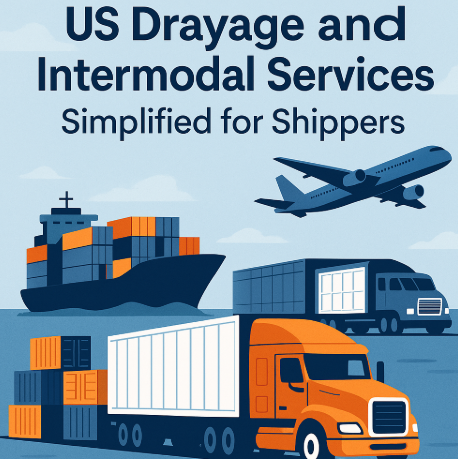
In today’s competitive logistics environment, many shippers struggle with port congestion, container delays, and rising transportation costs. US drayage and intermodal services have become essential for solving these challenges by connecting ports, rail terminals, and distribution centers into one efficient system. This integrated solution allows freight to move faster, cheaper, and more reliably — ensuring seamless port-to-door logistics across the country.
What Are US Drayage and Intermodal Services?
US drayage and intermodal services connect short-haul truck moves with long-haul rail or ocean segments. Drayage refers to the short-distance transport of containers between ports, rail ramps, and warehouses, while intermodal services combine multiple modes — usually truck and rail — under one seamless contract.
These services play a critical role in import/export logistics, bridging the gap between ocean carriers and inland destinations. A single intermodal solution reduces handling, cuts emissions, and speeds up delivery by eliminating unnecessary handoffs.
How Do Drayage and Intermodal Transport Work Together?
Typically, an import container arrives at a seaport. A drayage truck retrieves it and hauls it to an intermodal rail terminal. From there, the container travels by train to an inland city, where another drayage carrier delivers it to the consignee. This connected flow ensures efficient container utilization and reduces highway congestion.
Example workflow:
Container unloaded from vessel at Los Angeles port.
Drayage truck moves it to UP Rail Terminal in Fontana.
Rail transport to Chicago hub.
Drayage truck delivers it to consignee warehouse.
Why Are US Drayage and Intermodal Services So Important?
Because over 70% of US imports pass through major ports like Los Angeles, Long Beach, Savannah, and New York/New Jersey, congestion is inevitable. Drayage and intermodal systems absorb this volume by moving containers inland faster, reducing port dwell time. Moreover, intermodal solutions cut carbon emissions by up to 60% compared to over-the-road trucking — a key factor for companies aiming to meet sustainability goals.
Key Advantages of Using Intermodal and Drayage Logistics
Transportation Mode
Average Cost per Mile
Average Transit Time
Best For
Truck (FTL)
$2.50–$3.00
1–4 days
Urgent domestic freight
Intermodal Rail
$1.30–$1.80
3–7 days
Long-haul shipments over 750 miles
Ocean + Drayage Combo
$0.80–$1.20
10–25 days
Imports from overseas origins
Key takeaways:
Intermodal rail reduces cost by 30–40%.
Drayage ensures port clearance within hours instead of days.
Combined services enable visibility from origin to destination.
How Drayage Improves Supply Chain Efficiency
Efficient drayage operations prevent bottlenecks that cause detention and demurrage fees. By scheduling precise pickup and return windows, logistics providers can optimize container cycles and equipment availability.
Velotactlcs Logistics uses real-time dispatch systems and GPS-tracked drayage trucks to coordinate port pickups, yard storage, and last-mile deliveries, minimizing idle time and maximizing throughput.
When Should Shippers Choose Intermodal Services?
Intermodal shipping is ideal for freight that:
Moves over 700 miles or more domestically.
Has non-urgent but predictable delivery schedules.
Involves heavy or bulky cargo that fits standard containers.
Requires balanced cost-to-speed ratio rather than express transit.
For example, moving automotive parts from Los Angeles to Chicago via intermodal rail typically costs 35% less than full-truckload — with only a 1–2 day difference in transit time.
Common Challenges in US Drayage and How to Solve Them
Challenge
Description
Solution
Port Congestion
High vessel arrivals cause truck delays.
Schedule flexible appointments; use nearby off-dock yards.
Equipment Shortage
Chassis or container scarcity during peak season.
Partner with asset-based carriers and monitor equipment pools.
Communication Gaps
Lack of real-time status updates.
Integrate EDI/API systems for live visibility and tracking.
Rising Fuel Costs
Impacts drayage rates and margins.
Use route optimization and backhaul matching.
By addressing these areas, logistics providers keep freight flowing smoothly and customers satisfied.
How Velotactlcs Logistics Supports Your Drayage and Intermodal Needs
At Velotactlcs Logistics, we specialize in integrating drayage, transload, and intermodal solutions across major US ports and rail hubs. Our services include:
Port drayage at Los Angeles, Long Beach, Houston, and Savannah.
Rail connections to inland terminals such as Chicago, Dallas, and Kansas City.
Real-time container tracking through API dashboards.
Flexible transload and warehouse options for FCL/LCL cargo.
This unified approach simplifies complex freight flows, reducing total transit time and ensuring your cargo reaches its final destination on schedule.
Visibility platforms integrate real-time status updates for customers.
These innovations are transforming traditional drayage into a transparent, eco-friendly, and data-driven process.
Conclusion
US drayage and intermodal services are the backbone of modern freight movement, combining speed, efficiency, and sustainability. By linking short-haul drayage with long-haul rail, shippers can cut costs, reduce delays, and gain end-to-end visibility. With Velotactlcs Logistics, your cargo moves smarter — from port to door — through reliable, connected, and eco-efficient transport solutions.
Need a quote?
Ready to get started? Contact us now to request a free shipping quote.