
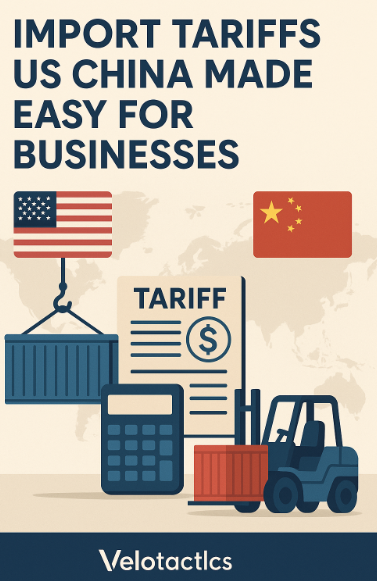
Cross-border trade between China and the United States remains one of the most influential drivers of global supply chains. However, many importers struggle with the complexity of tariff regulations, duty rates, compliance documents, and valuation rules. Because tariff policies shift frequently, businesses often experience confusion about how much they need to pay and how to plan their logistics. Therefore, this guide clarifies everything you need to understand about import tariffs US China so your business can ship confidently and cost-effectively.

What Are Import Tariffs US China and Why Do They Matter?
Since tariffs directly affect total landed cost, understanding import tariffs US China is essential for budgeting and supply-chain planning. Tariffs are government-imposed taxes on imported goods, generally based on the HTS classification, declared value, and country of origin.
Moreover, tariffs influence:
- Product pricing
- Profit margins
- Inventory planning
- Customer demand
- Supply-chain stability
Additionally, tariff rates for China-origin goods may include base duties, Section 301 tariffs, and sometimes AD/CVD tariffs depending on the product category. Therefore, businesses must track all applicable tariff layers—not just the standard duty rate.
How Are Import Tariffs US China Calculated?
Although tariffs appear complicated, the core calculation follows a simple formula:
Total Duty = (Declared Customs Value × Duty Rate) + Additional Tariffs (if applicable)
Customs value typically includes:
- Cost of goods
- Freight cost to the U.S. port
- Insurance
This is known as the CIF value. Because accuracy is vital, customs compares all numbers across documents to ensure consistency.
Tariff layers that may apply:
- Base HTS Duty (varies by product)
- Section 301 Tariff (commonly 7.5–25%)
- Anti-Dumping or Countervailing Duty (AD/CVD) (product-specific)
- Excise taxes (limited categories)
Therefore, importers must verify each tariff type before shipping to estimate the true landed cost.
What Is Section 301 and How Does It Affect Imports From China?
Section 301 is a U.S. trade action that adds additional duty to many products imported from China. These tariffs, often ranging from 7.5% to 25%, apply on top of the base HTS duty rate.
Key points about Section 301:
- Not all Chinese products are subject to it
- Exclusions may apply to certain goods
- Exclusion renewals can change annually
- Section 301 applies regardless of shipper or buyer
Additionally, classification accuracy determines whether your product is affected. Since tariff changes occur periodically, verifying current lists is essential.
Velotactlcs Logistics often helps importers identify correct tariff rates and evaluate cost-saving strategies for compliant importing.
Which Products Commonly Face High Import Tariffs US China?
Duty levels differ significantly across industries.
Table 1 — Examples of Tariff Rates for Popular China-Origin Imports
| Category | Base Duty Rate | Section 301 Rate | Notes |
|---|---|---|---|
| Electronics | 0–2% | 0–25% | Varies by HTS code |
| Furniture | 0–4% | 25% | Wood and fabric type impact rates |
| Apparel | 5–32% | Often exempt | Fiber content determines rate |
| Footwear | 8–37% | 0–25% | Very specific classification rules |
| Machinery | 2–5% | 7.5–25% | Industrial goods often targeted |
| Toys | 0% | 0–25% | One of the largest categories |
Because duty rates are often updated, importers should verify their classifications before booking freight.
Which Documents Influence Tariff Assessment?
Accurate paperwork ensures correct tariff application.
Table 2 — Essential Customs Documents
| Document | Purpose |
|---|---|
| Commercial Invoice | Confirms value and transaction details |
| Packing List | Ensures quantity and dimensional accuracy |
| Bill of Lading / Air Waybill | Shows routing and carrier info |
| HTS Classification Sheet | Determines duty and tariff rates |
| Country of Origin Declaration | Confirms China-origin status |
| Customs Bond | Required for commercial imports |
| FDA/USDA/Other Agency Docs | For regulated items |
Since customs compares data across all documents, even small inconsistencies can trigger delays.
How Does HTS Classification Affect Import Tariffs US China?
HTS codes determine:
- Duty rate
- Section 301 applicability
- AD/CVD relevance
- Required permits
- Documentation requirements
Accurate classification is the foundation of correct tariff calculation.
Because HTS categories are extremely detailed, small product differences—such as material composition or manufacturing process—can lead to different tariff outcomes.
For example:
- Plastic chair vs. wooden chair
- Battery-powered toy vs. non-powered toy
- Cotton vs. synthetic apparel
Therefore, classification expertise helps importers avoid costly mistakes.

Do Different Shipping Methods Affect Tariff Amounts?
Tariff rates stay the same regardless of shipping method.
However, shipping choices influence:
- Customs process
- Clearance time
- Required filings
- Total logistics cost
Table 3 — Transport Method Impact
| Shipping Method | Clearance Speed | Cost Level | Tariff Effect |
|---|---|---|---|
| Air Freight | Fast | High | No change |
| Ocean Freight FCL | Medium | Low | No change |
| Ocean Freight LCL | Slower | Medium | No change |
| Express Courier | Very fast | High | No change |
Additionally, express courier companies sometimes pre-pay duties and bill the importer afterward, which simplifies clearance for small shipments.
Why Do Tariffs Change Over Time?
Tariffs shift due to:
- Trade negotiations
- Political changes
- Industry lobbying
- Market conditions
- Supply-chain disruptions
- Annual HTS updates
Therefore, businesses should review tariff updates quarterly to maintain accurate cost planning.
Are There Ways to Reduce Import Tariffs US China?
Yes—several legal methods help importers reduce tariff exposure.
Tariff Reduction Strategies:
- Verify correct HTS classification
- Use tariff exclusions if available
- Shift to components instead of finished goods
- Use Foreign Trade Zones (FTZs)
- Re-classify goods with more precise descriptions
- Use duty drawback for re-exports
- Evaluate alternative sourcing routes
Additionally, some businesses reconsider packaging, manufacturing steps, or assembly locations to reduce tariff impact legally.
How Does Valuation Impact Tariff Costs?
Customs must confirm that declared value reflects the true transaction value.
Valuation errors cause:
- Delays
- Reassessment
- Penalties
- Duty repayment
Therefore, invoices must reflect:
- True product cost
- Accurate shipping and insurance rates
- Correct Incoterms
Moreover, customs requires transparent documentation to support declared values.
What Causes Delays or Problems With Import Tariffs US China?
Common issues include:
- Incorrect HTS codes
- Missing invoices
- Undeclared components
- Incorrect packing lists
- Misstated country of origin
- FDA/USDA non-compliance
- Inaccurate tariff declarations
Because of these risks, many companies rely on Velotactlcs Logistics for classification checks and documentation review before cargo departs China.
Conclusion
Therefore, understanding import tariffs US China is essential for businesses managing global supply chains, cost planning, and compliance. Because tariff layers—base duty, Section 301, and potential AD/CVD—significantly influence landed cost, importers must classify products correctly and verify all documentation before shipping.
Moreover, knowing how tariff rules work helps companies avoid delays, reduce unexpected costs, and maintain smoother logistics operations. With accurate HTS codes, complete paperwork, and a consistent strategy, importers can navigate tariff regulations confidently and efficiently.
Need a quote?
Ready to get started? Contact us now to request a free shipping quote.
Frequently Asked Questions (FAQ)
Not all goods are included. Many categories are excluded, so checking the HTS code is essential before shipping.
You can check the HTSUS database or consult a customs broker. Clear classification ensures accurate tariff calculations.
No. Tariffs remain the same for air, sea, or express shipments, though fees and clearance procedures differ.
Shipments under $800 qualify for the de minimis rule, which avoids duty, but Section 301 may still apply depending on category.
Reclassification occurs when descriptions do not match the product features. Accurate documentation prevents errors.