
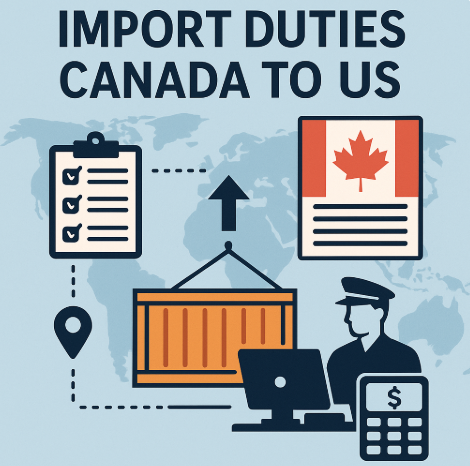
Cross-border trade between Canada and the United States expands every year, yet many importers still encounter surprises with tariff charges, document issues, and customs delays. Therefore, this comprehensive guide helps you understand how import duties Canada to US truly work, and more importantly, how to avoid costly mistakes. Because accurate preparation and clear processes matter, the following sections walk you through real duty calculations, documents, USMCA rules, and strategies for smooth importing.

What Are Import Duties Canada to US and Why Do They Matter?
Import duties Canada to US refer to the legally required taxes that US Customs and Border Protection (CBP) charges when goods enter the United States from Canada. Although the USMCA agreement reduces duties for many qualifying goods, importers must still check HS codes, product origin, and valuation rules. Additionally, duty errors often slow clearance, cause penalties, or increase landed costs unexpectedly.
Because tariff structure varies by industry, understanding the full duty ecosystem gives importers better control of pricing and cash flow. Furthermore, knowing the true landed cost helps companies set accurate customer pricing and maintain profit margins. While many importers assume duty is a flat charge, it actually changes based on product classification, documentation, and shipping method.
In many cases, companies ignore smaller cost components such as MPF or HMF, which leads to inaccurate cost forecasting. Therefore, companies must learn not just the duty rate but the entire customs cost formula.
How Does USMCA Change Import Duties from Canada to the US?
The United States–Mexico–Canada Agreement (USMCA) allows eligible Canadian-origin goods to enter the United States duty-free. However, qualifying for zero duty requires strict compliance with the agreement’s rules of origin. Because many items use components sourced globally, not every product manufactured in Canada qualifies for duty exemption.
Additionally, goods must be accompanied by a USMCA certificate of origin, which proves qualifying status. Without this document, CBP will charge full duty even if the goods meet origin criteria. Therefore, importers must ensure that suppliers provide complete origin documentation before international shipping.
Which Goods Qualify for Zero Duty Under USMCA?
- Products made entirely or substantially in Canada
- Goods meeting regional value content (RVC) requirements
- Specific industries: automotive, machinery, plastics, textiles, electronics
When Do Duties Still Apply Even With USMCA?
- Goods containing large amounts of non-USMCA components
- Items incorrectly classified
- Shipments missing a valid certificate of origin
- Products not meeting RVC thresholds
Therefore, importers should verify classification and origin early to avoid unexpected duty charges.

How Are Import Duties Canada to US Calculated?
Duty calculation follows a structured formula: HS code → duty rate → customs valuation → applicable import fees. Because CBP uses the transaction value method, the declared commercial invoice value plays the largest role. Moreover, freight and insurance may be included in the calculation depending on Incoterms.
Key Components of Total Import Cost
| Cost Component | Applies to Canada→US? | Description |
|---|---|---|
| Import Duty | Yes (when not USMCA-qualified) | Based on HS code duty rate |
| MPF (Merchandise Processing Fee) | Yes | 0.3464% of value, min & max apply |
| HMF (Harbor Maintenance Fee) | Only ocean freight | 0.125% of cargo value |
| Excise Tax | Select products | Fuel, alcohol, tobacco, vehicles |
| Brokerage Fee | Optional | Customs broker service charge |
Because duty applies before MPF and HMF, importers must calculate the charges in proper sequence. Additionally, undervaluing goods leads to penalties, so accuracy is essential.
What HS Codes Mean for Your Canada-to-US Import Duties?
HS codes determine your product’s legal identity at the border, controlling its duty rate. Therefore, a misclassified product may face incorrect tariffs or enforcement actions. Because many items have similar descriptions, importers often struggle with accurate classification, especially for multi-material goods or kits.
Additionally, CBP may request product samples or technical sheets for verification. Consequently, importers should double-check classification with experienced brokers or logistics partners. Furthermore, Velotactlcs Logistics offers HS code verification to help importers prevent costly misclassifications.
How to Prepare Required Customs Documents for Canada-to-US Shipments?
Accurate documentation is essential for fast clearance. Without complete paperwork, CBP delays shipments for inspection or requests additional information. Because documentation mistakes are extremely common, importers must create a consistent workflow for all required forms.
Common Customs Documents Checklist
| Document | Purpose | Notes |
|---|---|---|
| Commercial Invoice | Declares value & details | Must match shipment info |
| Packing List | Confirms quantities | Needed for inspection |
| Bill of Lading / Air Waybill | Transport record | Provided by carrier |
| HS Code Declaration | Classification | Must be accurate |
| USMCA Certificate | Duty reduction | Needed for qualified goods |
| Importer ID (EIN) | Import identity | Required for entry filing |
Moreover, importers should keep all documents consistent across invoices, packing lists, and certificates to avoid CBP queries.
What Are the Typical Duty Rates for Popular Canadian Exports?
Although many goods qualify for zero duty under USMCA, some categories still require tariff evaluation. Below is a reference table with commonly shipped items and indicative duty considerations.
Sample Duty Rates for Common Canadian Exports
| Product Category | Typical Duty Situation | Notes |
|---|---|---|
| Auto Parts | 2.5% (if non-USMCA) | Complex origin rules |
| Machinery | 1–4% | Varies by material |
| Furniture | 0–2.5% | Wood vs metal differs |
| Plastics | 3–6.5% | Depends on polymer type |
| Processed Foods | Varies widely | Labeling rules apply |
| Steel & Metal | Duty or anti-dumping | Depends on origin |
Therefore, verifying item-specific tariffs is essential before shipping.
How Shipping Method Affects Import Duties and Total Cost?
Shipping method does not change the duty rate, but it does influence other customs fees. Because MPF applies to all imports and HMF applies only to ocean shipments, your logistics choice affects total landed cost.
Truck Freight vs Air Freight vs Ocean Freight
- Truck Freight
Fastest border crossing; ideal for regular Canada–US trade; MPF applies. - Air Freight
Higher transport cost but faster clearance; ideal for urgent shipments. - Ocean Freight
Suitable for large volumes; HMF applies; slower processing time.
Therefore, importers should balance speed, cost, and customs fees when choosing a shipping mode.
How to Reduce Import Duties Canada to US Legally?
Even though duties cannot always be eliminated, smart compliance reduces the total cost significantly. Additionally, importers can structure sourcing and documentation in ways that improve USMCA eligibility.
Practical strategies include:
- Ensuring supplier provides valid USMCA certificate
- Using accurate HS classification
- Avoiding undervaluation or incomplete invoices
- Splitting shipments strategically to manage MPF caps
- Reviewing Incoterms to control the valuation base
Therefore, planning your shipments early helps reduce duty exposure.
How Velotactlcs Logistics Helps You Avoid Border Delays
Velotactlcs Logistics offers complete Canada-to-US shipping solutions, including HS code support, document validation, duty forecasting, and customs brokerage coordination. Because our team handles every step precisely, your shipments move faster while reducing tariff risks. Moreover, our cross-border network helps importers simplify compliance even during peak periods.

Conclusion
Understanding import duties Canada to US enables companies to manage costs confidently, avoid penalties, and ensure smooth border operations. Moreover, correct HS coding, full documentation, and USMCA compliance all play critical roles in successful importing. Therefore, working with an experienced logistics partner improves your efficiency and protects your margins. If you want predictable duty costs and reliable cross-border performance, Velotactlcs Logistics is ready to support your growth.
Need a quote?
Ready to get started? Contact us now to request a free shipping quote.
Frequently Asked Questions (FAQ)
Clearance typically takes a few hours for truck freight and up to one day for air freight unless documents contain errors.
No. Goods must meet origin rules and have a valid USMCA certificate to qualify for zero duty.
Yes. Digital certificates are acceptable as long as all required data fields are complete.
Not always. However, a broker is strongly recommended if products have complex HS codes.
Samples may still incur duties depending on value, HS code, and intended use.