
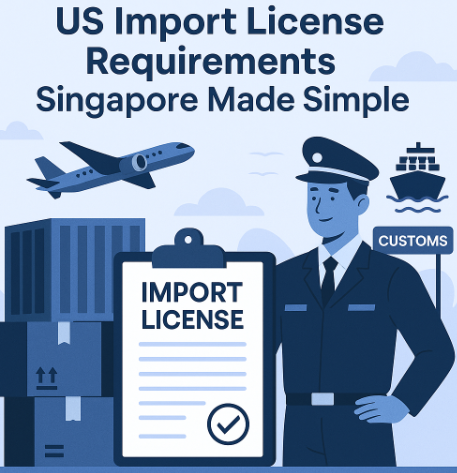
US import license requirements Singapore processes have become increasingly important for businesses moving goods between two major global trade hubs. Because the United States requires specific licenses for certain regulated commodities—while Singapore enforces its own export controls—importers must balance compliance, documentation, and logistics timing to avoid delays. With the right guidance, companies can streamline approvals, reduce clearance risks, and manage end-to-end supply chain activities confidently.

What Makes US Import License Requirements Singapore So Important?
Many importers assume all goods entering the US require the same paperwork. However, different product categories fall under unique federal agencies with their own licensing rules. Moreover, when sourcing from Singapore—known for electronics, chemicals, medical devices, and precision components—compliance becomes even more critical.
Long-tail keywords included: Singapore to USA import rules, US import permit Singapore, Singapore export documentation, US compliance requirements Singapore, import regulations Singapore to USA.
Consequently, understanding licensing requirements improves cost accuracy, transit predictability, and customs performance.
What Types of Goods From Singapore Require US Import Licenses?
Although many general goods require no import license, certain categories do. Below is a summary:
| Product Category | License Agency | Notes |
|---|---|---|
| Electronics with communication modules | FCC | RF testing & labeling |
| Medical devices | FDA | Class I–III rules |
| Food & supplements | FDA | FCE/SID, labeling |
| Chemicals & solvents | EPA | Hazard classification |
| Firearms & optics | ATF | Strict import licensing |
| Defense items | DDTC (ITAR) | Highly regulated |
| Plants & wood products | USDA/APHIS | Inspection required |
Because Singapore exports many high-tech items, importers often require FCC or FDA-related documentation.

How Do Singapore’s Export Procedures Affect US License Requirements?
Singapore maintains strict export controls under the Strategic Goods (Control) Act. Therefore, goods such as advanced electronics, military components, chemicals, and dual-use products may require an export permit before leaving Singapore.
Although this process is separate from US licensing, both sides must match. Any misalignment between Singapore’s export code and the US HS code may trigger holds or reclassification.
Moreover, Velotactlcs Logistics helps importers verify whether both countries’ rules apply to a shipment before booking freight.
What Documents Are Required to Comply With US Import License Requirements Singapore?
Below is a consolidated checklist importers can use:
| Document | Purpose |
|---|---|
| Commercial Invoice | Declares value & product details |
| Packing List | Confirms quantity & dimensions |
| Certificate of Origin | Identifies Singapore origin |
| HS/HTS Code Sheet | Determines duty & licensing |
| Bill of Lading / Air Waybill | Transportation document |
| Compliance Licenses | FCC/FDA/ATF/EPA etc. |
| Singapore Export Permit | Required for controlled items |
| ISF Data (for Sea Freight) | Mandatory 24 hrs before loading |
Because error-free documentation reduces customs risk, importers often rely on logistics partners to verify details in advance.
How Does the US Import License Process Work for Singapore-Origin Goods?
Import approval depends on the agency regulating the product:
- FCC: Ensures radio frequency compliance for electronics
- FDA: Oversees food, cosmetics, medical devices, and supplements
- EPA: Monitors chemicals, pesticides, and hazardous goods
- ATF: Regulates firearms, munitions, and related optics
- USDA: Oversees agricultural products
Although Singapore exporters often follow strong compliance standards, US requirements involve additional classification steps.
Moreover, early classification prevents delays during customs filing.
How Shipping Mode Impacts US Import License Requirements From Singapore
Shipping mode affects how and when documents must be filed:
| Mode | Compliance Impact | Notes |
|---|---|---|
| Air Freight | Faster clearance; FDA & FCC checks may occur at airport | Best for urgent sensitive cargo |
| Sea Freight (FCL) | Requires ISF filing; more FDA exams possible | Stable for bulk items |
| LCL | Additional handling; higher inspection risk | Suitable for small shipments |
| Express Courier | Carrier handles most paperwork | Limited for regulated items |
Because licensing complexity varies, selecting the right mode is essential when importing sensitive goods.
Why Do US Importers Choose Singapore as a Sourcing Hub?
Singapore offers:
- Advanced manufacturing quality
- Strict compliance and safety standards
- Stable supply chain and transit reliability
- Strong specialty sectors (electronics, chemicals, biomedical)
- Competitive lead times
- Lower disruption risk
Additionally, port efficiency and airport connectivity improve predictability—an advantage for regulated products requiring licensing.
How Velotactlcs Logistics Supports License Compliance for Singapore–USA Imports
Velotactlcs Logistics specializes in Singapore–USA lanes by offering:
- License requirement verification (FCC/FDA/EPA/ATF/USDA)
- HS code validation
- Documentation coordination with Singapore suppliers
- ISF filing and customs entry management
- Singapore export permit confirmation
- Air/Sea freight planning aligned with compliance rules
- Final delivery to US warehouses or Amazon FBA
Because we combine regulatory expertise with operational support, importers avoid delays caused by licensing mistakes.
Real Case Studies: Import License Requirements Successfully Managed
- Product: Communication modules (RF-enabled)
- Weight: 190 kg
- Mode: Air freight
- License: FCC SDoC
- Time: 5 days clearance
Result: Pretested RF compliance avoided costly retesting at US arrival.
- Cargo: Diagnostic kits, 2.8 CBM
- Mode: LCL + Trucking
- License: FDA Class II documentation
- Clearance Time: 4 days
Result: Proper documentation reduced hold time during FDA review.
- Cargo: 1×20GP
- Mode: Sea freight
- License: EPA certification
- Handling: MSDS + labeling
Result: Dangerous goods documentation prevented inspection penalties.
How to Determine If Your Product Needs a US Import License?
Importers should:
- Identify correct HS/HTS code
- Check corresponding regulatory agency
- Confirm Singapore export control category
- Review product labeling requirements
- Verify whether the item is “dual-use”
- Work with a logistics provider for pre-checks
Because incorrect classification is the #1 cause of customs holds, early verification improves clearance speed.
What Are the Transit Times From Singapore to the United States?
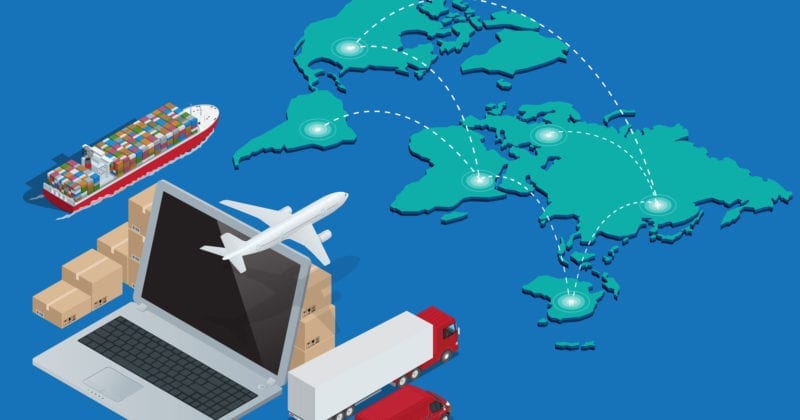
| Route | Transit Time | Notes |
|---|---|---|
| Singapore → Los Angeles | 19–26 days | Fastest sea route |
| Singapore → New York | 28–38 days | Longer sailing |
| Singapore → Dallas (Air) | 4–7 days | Best for sensitive goods |
| Singapore → Chicago (Air) | 5–8 days | Frequent flights |
These timelines help importers plan licensing approvals before cargo arrival.
Conclusion
US import license requirements Singapore shipments must follow detailed regulatory steps involving HS code accuracy, compliance documentation, and agency-specific approvals. Although the process may seem complex, professional coordination ensures smooth customs entry and predictable logistics performance. Velotactlcs Logistics provides complete regulatory support and end-to-end freight handling, helping importers achieve full compliance and stress-free operations for every Singapore–USA shipment.
Need a quote?
Ready to get started? Contact us now to request a free shipping quote.
Frequently Asked Questions (FAQ)
No. Only certain regulated categories—like electronics, medical devices, and chemicals—require licenses.
Yes, if the device contains RF modules. FCC testing or SDoC may be required.
Sea freight requires ISF filing, but license requirements depend on product type.
Many can, but accuracy varies. Professional review prevents mistakes.
They require proper FDA documents, but clearance is smooth when forms are correct.