
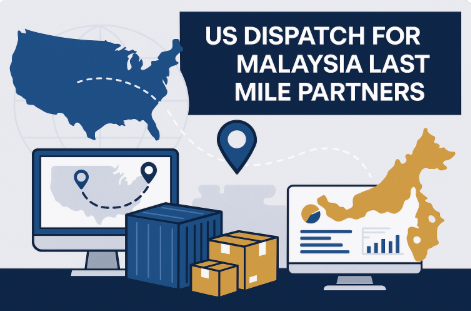
Cross-border shippers increasingly rely on us dispatch for Malaysia last mile partners to eliminate visibility gaps and reduce unpredictable delivery delays. As e-commerce and B2B imports expand rapidly across Malaysia, businesses need a dispatch workflow that enhances tracking transparency, stabilizes routing, and supports efficient coordination between US warehouses and Malaysia last mile carriers.

Why Us Dispatch for Malaysia Last Mile Partners Matters Today
Many Malaysia last mile partners face daily bottlenecks—such as fluctuating freight rates, inconsistent transit time planning, and incomplete customs documentation—which disrupt end buyers’ experience. Therefore, a fully optimized US dispatch model helps unify scheduling, export prep, cargo consolidation, and cross-border coordination.
What Challenges Malaysia Last Mile Partners Face When Receiving US Shipments
Most delays originate before the cargo even leaves the United States. Additionally, incomplete packing lists, slow truck appointments, and late warehouse cut-offs increase operational risk. Malaysia last mile partners also report visibility issues due to fragmented supply chain systems and scattered communication channels.
Key pain points include:
- Unpredictable port congestion
- Inconsistent delivery schedules
- Limited shipment visibility across multiple carriers
- Manual customs and export workflows
- Poor coordination between warehouses and line-haul routing

How Us Dispatch for Malaysia Last Mile Partners Improves Shipment Visibility
A streamlined US dispatch workflow builds end-to-end transparency. Moreover, by integrating digital tracking, advanced routing tools, and pre-alert automation, shippers maintain real-time visibility throughout the import/export process. This approach also minimizes gaps between US pickup, export cut-off, and Malaysia last mile delivery.
Key Visibility Enhancements
- Unified cargo status dashboard
- Integrated customs preparation
- Automated milestone updates
- Predictable transit time windows
- Shipment-level inventory mapping
What Processes Shape an Efficient US Dispatch Workflow
Every handoff—from US factory pickup to Malaysia last mile receipt—must follow a synchronized process. Furthermore, by managing consolidation service, warehouse handling, carrier booking, and export clearance under one coordinated system, shippers lower cost while enhancing predictability.
Typical US Dispatch Steps
- Cargo receiving and verification
- Barcoding and digital inventory
- Consolidation or direct-load planning
- Export documentation and customs readiness
- Carrier booking and container loading
- Sailing, tracking, and Malaysia notification
- Final handover to last mile partners
How Long Transit Times Affect Malaysia Last Mile Partners
Transit time fluctuations often create downstream backlog. However, with a structured US dispatch approach, shippers forecast delays earlier, enabling Malaysia delivery partners to adjust routing, staffing, and customer communication.
Sample Transit Time Comparison
| Route | Mode | Transit Time | Notes |
|---|---|---|---|
| US West → Port Klang | Ocean FCL | 22–28 days | Most stable for volume freight |
| US Midwest → Penang | Ocean LCL | 28–35 days | Extra time for consolidation |
| US East → Johor | Air Freight | 3–6 days | Best for urgent replenishment |
How Customs Readiness Strengthens Malaysia Last Mile Delivery
Proper US export compliance directly speeds up Malaysia import clearance. Therefore, dispatch teams must finalize commercial invoices, HS codes, AES filings, and packing lists before cargo moves to the terminal. Moreover, Malaysia last mile partners benefit from earlier pre-alert files, allowing them to prepare import permits and tax estimates ahead of arrival.
Essential Customs Checklist
| Document | Purpose | Impact on Malaysia Delivery |
|---|---|---|
| Commercial Invoice | Declares value | Prevents customs hold |
| Packing List | Confirms SKU and quantity | Ensures warehouse accuracy |
| HS Codes | Classification | Avoids duty errors |
| AES Filing | US export requirement | Reduces last-minute delays |
How Malaysia Last Mile Partners Benefit From Consolidation Services
Bundling multiple purchase orders into a single export load significantly reduces freight rates and warehouse handling cost. Additionally, consolidation improves container utilization and stabilizes shipping schedules—giving last mile teams more predictable volume.
Common Scenarios for Using Consolidation
- Multiple small suppliers shipping to one Malaysia buyer
- E-commerce replenishment cycles
- High-mix, low-volume SKU shipments
- Cost-saving strategies for SMEs
Soft Promotion:
Velotactlcs Logistics offers optimized consolidation plans designed specifically for US-to-Malaysia flows, enabling smoother last mile distribution and lower total shipping cost.
Case Study Cards
- Cargo Type: Consumer electronics (12 CBM)
- Mode: LCL consolidation
- Cost: 38% lower vs independent small shipments
- Transit Time: 26 days door to port
- Result: Malaysia last mile partner achieved a synchronized delivery window with full SKU visibility.
- Cargo Type: Cartonized health supplements (1x40HQ)
- Mode: FCL
- Cost: Stable freight rate with advanced booking
- Transit Time: 29 days
- Result: Import tasks completed early because dispatch provided complete customs documents ahead of schedule.
- Cargo Type: Mixed apparel SKUs
- Mode: Air freight
- Cost: Higher tier but essential for urgent peak-season demand
- Transit Time: 5 days
- Result: Last mile partner maintained campaign delivery deadlines without stockouts.
Why Visibility Tools Matter for Malaysia Last Mile Partners
Digital visibility eliminates the guesswork. Furthermore, with barcode mapping, real-time tracking, and automated milestones, last mile providers adjust delivery routes, optimize manpower, and notify customers with confidence.
Soft Promotion:
Velotactlcs Logistics provides a unified visibility platform allowing Malaysia partners to track US dispatch progress from pickup through final handover.

How Malaysia Last Mile Teams Use Data to Reduce Delays
Predictive data helps partners adjust driver assignments, warehouse space, and customer communication. Additionally, advanced forecasting prevents bottlenecks during peak seasons by aligning US export cycles with Malaysia import workflows.
Should Shippers Use FCL or LCL for Malaysia Last Mile Coordination?
Choosing the wrong mode affects pricing, delivery schedules, and routing flexibility. Consequently, selecting the right mode based on SKU mix, volume, and speed requirements is essential.
FCL vs LCL Comparison
| Criteria | FCL | LCL |
|---|---|---|
| Cost Efficiency | Better for large volume | Suitable for small shipments |
| Predictability | Higher | Medium |
| Handling Time | Faster | Slower due to consolidation |
| Best Use | High-volume importers | Multi-supplier shipments |
Conclusion
A refined US dispatch for Malaysia last mile partners creates a predictable, transparent, and cost-efficient supply chain. Moreover, with stronger customs preparation, optimized consolidation, and improved visibility tools, shippers support smoother last mile delivery performance. For brands seeking consistent growth, this coordinated approach ensures reliability and better customer experience across borders.
Need a quote?
Ready to get started? Contact us now to request a free shipping quote.
Frequently Asked Questions (FAQ)
Better planning and early documentation reduce congestion and support faster import clearance.
Key documents include invoice, packing list, HS codes, and export filings to prevent customs delays.
Yes, combining orders boosts container utilization and stabilizes delivery schedules.
Tracking tools give real-time updates that help optimize routing and manpower planning.
Air works best for urgent, high-value items requiring strict delivery windows.