Cross-border supply chains continue to expand rapidly, and many shippers now rely on us dispatch barcode handling for Asian exporters to maintain end-to-end accuracy and reduce costly mistakes. As barcode workflows become essential for tracking, data integrity, and order fulfillment, exporters need a dispatch process that simplifies scanning, labeling, and shipment mapping across multiple destinations. Because global demand keeps rising, barcode handling must support faster processing and better visibility from warehouse receiving to international loading.
Why Us Dispatch Barcode Handling for Asian Exporters Matters More Than Ever
Exporters across Asia face growing pressure to deliver accurate SKU-level data while managing fluctuating freight rates, complex customs requirements, and tighter delivery schedules. Moreover, barcode errors often cause shipment delays, inventory discrepancies, and container misloads. Therefore, well-structured US dispatch barcode handling ensures clean data flow and reduces downstream problems for importers.
Key operational challenges include:
- SKU mismatch during receiving
- Manual labeling errors
- Outdated or inconsistent barcode formats
- Lack of real-time inventory tracking
- Delayed customs documentation
What Problems Poor Barcode Handling Creates in the US Dispatch Workflow
Incorrect, duplicated, or missing barcodes often trigger major workflow failures. Additionally, Asian exporters frequently report chargebacks, extra warehouse handling, and customs delays due to inaccurate data. Since US warehouses typically rely on automated scanning systems, any barcode inconsistency leads to time loss or misclassification during cargo processing.
Common issues include:
- Shipment misrouting
- Lost items in mixed pallets
- Skipped scans during consolidation
- Incorrect packing list entries
- Extended loading times
How Effective Barcode Processing Strengthens Exporters’ Supply Chain Control
A precise barcode workflow enhances shipment visibility, minimizes transit time disruptions, and ensures more predictable cross-border performance. Furthermore, automated scanning allows dispatch teams to validate cargo instantly, generate accurate documentation, and provide partners with real-time data feeds.
Core Benefits of Reliable Barcode Handling
- Cleaner SKU-level data
- Faster outbound processing
- Fewer customs-related discrepancies
- Higher shipping accuracy
- Better coordination between US warehouses and Asian exporters
How Barcode Handling Works in a Typical US Dispatch Process
Barcode workflows integrate directly with receiving, consolidation, and export preparation. Additionally, a structured sequence ensures that all cargo is scanned, mapped, and validated before reaching the container loading stage.
Standard Barcode Workflow
- Cargo receiving and verification
- Barcode scanning and label matching
- Data mapping to SKU database
- Pick-and-pack validation
- Inventory reporting
- Export document generation
- Loading confirmation and pre-alert
What Barcode Types Asian Exporters Commonly Use
Selecting the proper barcode format affects scan speed, accuracy, and system compatibility. Consequently, exporters should standardize formats across suppliers to prevent warehouse errors.
Popular Barcode Formats
- EAN-13 for consumer goods
- UPC-A for retail items
- Code 128 for logistics and pallets
- QR codes for advanced data storage
LSI terms used: supply chain, import/export, logistics trends.
How Barcode Accuracy Impacts Transit Time and Delivery Schedules
Accurate barcode scanning reduces warehouse rework, significantly speeding up dispatch and international loading. Moreover, clean labeling allows import-side systems to prepare earlier, shortening customs clearance and final delivery.
Transit Time Impact Comparison
| Workflow Type | Error Rate | Additional Time | Notes |
|---|---|---|---|
| Manual Labeling | High | +1–3 days | Frequent rescans and rework |
| Mixed Barcode Formats | Medium | +0.5–1 day | System mismatch issues |
| Standardized Barcode Handling | Low | None | Supports stable loading |
How Asian Exporters Can Improve Barcode Consistency
Exporters often work with multiple manufacturers, each using different labeling methods. Nevertheless, creating a unified barcode standard dramatically boosts efficiency across the entire export workflow.
Recommended Improvement Areas
- Standardizing label size and placement
- Using durable, smudge-resistant print material
- Verifying barcode readability before shipping
- Aligning documentation fields with barcode data
Soft Promotion:
Velotactlcs Logistics provides an integrated barcode inspection and validation system that helps Asian exporters reduce inconsistencies before dispatch.
Case Study Cards
- Cargo Type: Mixed consumer electronics (18 CBM)
- Barcode Type: Code 128
- Mode: LCL consolidation
- Transit Time: 21 days
- Result: Dispatch rework reduced by 42% after implementing uniform barcode mapping.
- Cargo Type: Garments in cartons
- Barcode Type: UPC-A
- Mode: FCL
- Transit Time: 28 days
- Result: US warehouse eliminated SKU mismatch, allowing faster pre-alert generation.
- Cargo Type: Palletized industrial tools
- Barcode Type: QR codes
- Mode: Air freight
- Transit Time: 4 days
- Result: QR-based documentation enabled data transfer to import ERP within minutes.
Why Barcode Mapping and Inventory Reporting Matter in US Dispatch
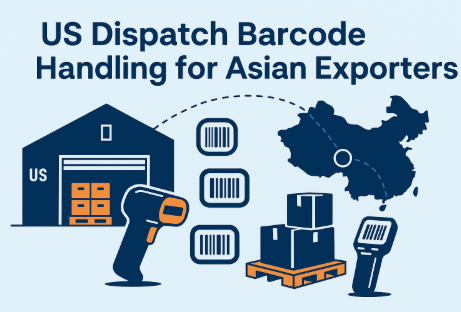
Barcode mapping ensures every SKU is connected to a digital record. Additionally, inventory reporting supports predictive supply chain planning, reduces order errors, and prevents carton-level discrepancies.
Key Mapping Elements
- SKU → carton → pallet → container hierarchy
- Lot and batch tracking
- Automated variance reporting
How Clean Barcode Data Supports Customs Preparation
Strong barcode workflows generate clean packing lists and commercial invoices automatically. Therefore, customs filings become faster and more accurate, reducing the probability of holds and inspections.
Customs Document Checklist
| Document | Barcode Dependency | Impact |
|---|---|---|
| Packing List | SKU-level matching | Prevents classification errors |
| Commercial Invoice | Accurate quantities | Supports import valuation |
| HS Code Sheet | Data mapping | Reduces customs inquiries |
| Manifest | Consolidation-level mapping | Ensures transparency |
Should Exporters Use Automated Scanning Systems?
Automation significantly reduces manual errors. Furthermore, automated scanners capture data faster, improving dispatch timing and supporting real-time visibility.
Advantages of Automated Scanning
- Faster container loading cycles
- Reduced workforce requirements
- Higher accuracy for high-mix shipments
Conclusion
Reliable us dispatch barcode handling for Asian exporters transforms global shipping accuracy, reduces rework, and improves delivery schedules. Additionally, it ensures cleaner data, smoother customs processes, and better end-to-end visibility. For exporters scaling their cross-border operations, adopting standardized barcode workflows helps build a resilient, high-performance supply chain.
Need a quote?
Ready to get started? Contact us now to request a free shipping quote.
Frequently Asked Questions (FAQ)
Choosing standardized formats such as Code 128 or UPC-A helps ensure warehouse compatibility.
Accurate barcodes generate cleaner documents that minimize customs questions and shorten clearance.
Yes, incorrect barcodes require rescanning or rework, slowing dispatch and causing avoidable delays.
Automation captures data instantly and reduces human errors, especially for high-mix shipments.
Unified labels reduce SKU mismatches and allow faster US warehouse processing.