
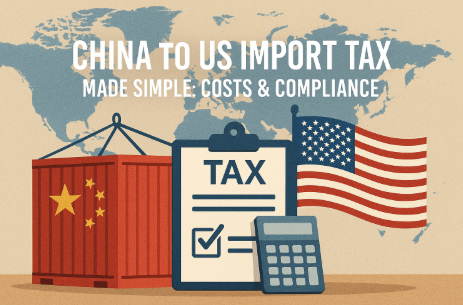
Importers sourcing goods from China face a wide range of duties, tariffs, and customs fees, and these charges directly affect profitability. Therefore, understanding china to us import tax—including how it’s calculated, which documents are required, and how to optimize cost—is essential for keeping shipments compliant and budgets predictable. Moreover, proper planning helps avoid delays and unexpected financial risk.

What Is China to US Import Tax and Why Does It Matter?
China to US import tax includes all charges applied to Chinese goods entering the United States. These charges typically include:
- Standard customs duties
- Section 301 tariffs
- Anti-dumping and countervailing duties
- Merchandise Processing Fee (MPF)
- Harbor Maintenance Fee (HMF)
Because these fees vary widely by HS code, product materials, and tariff lists, importers must calculate taxes before issuing purchase orders. Additionally, policy changes occur frequently, meaning importers should maintain updated knowledge to avoid compliance issues.
Velotactlcs Logistics supports importers with HS code reviews, customs preparation, and landed-cost planning to ensure every shipment remains compliant.
How Is China to US Import Tax Calculated?
Import tax calculation begins with the Harmonized Tariff Schedule (HTS). Since each product classification carries different duty and tariff rates, choosing the correct HS code is critical.
General formula:
Import Tax = Customs Value × (Duty Rate + Tariff Rate) + MPF + HMF (if ocean)
Example:
- Customs value: $20,000
- Duty rate: 5%
- Section 301 tariff: 25%
- MPF: 0.3464%
- HMF: 0.125%
Total tax ≈ $6,065
Because these taxes significantly affect margins, importers must calculate them early for proper pricing and budgeting.
Which Tax Categories Affect China to US Imports?
1. Standard Customs Duty
Based on HS classification and product type.
2. Section 301 Tariffs
A key cost factor for Chinese goods—common rates include 7.5% and 25%.
3. Anti-Dumping (AD) Duties
Applied when products are exported at unfairly low prices.
4. Countervailing Duties (CVD)
Applied when a foreign government subsidizes production.
5. MPF (Merchandise Processing Fee)
0.3464% of value (min $30.66, max $575.35).
6. HMF (Harbor Maintenance Fee)
0.125% for ocean freight entries.
Because these charges stack, accurate HS code selection and proper documentation become essential for cost control.
Which Products Face Higher China to US Import Taxes?
Below is a simplified comparison showing typical tax impact by product category.
| Product Category | Typical Duty Range | Section 301 Impact | Overall Tax Burden |
|---|---|---|---|
| Electronics | 0–4% | 7.5% | Low–Moderate |
| Furniture | 0–3% | 25% | High |
| Tools & Hardware | 2–8% | 25% | High |
| Machinery Components | 0–5% | 25% | High |
| Apparel & Textiles | 5–32% | 0% | Moderate–High |
| Toys | 0% | 7.5% | Low |
| Automotive Parts | 2–5% | 25% | High |
Because each sub-classification varies, importers should always verify exact HTS codes before shipping.
Which Documents Are Required for Customs Clearance and Tax Assessment?
Accurate documents ensure correct tax calculation and prevent customs delays. Since errors often trigger inspections, importers must verify all paperwork before departure from China.
| Document Needed | Reason It’s Required |
|---|---|
| Commercial Invoice | Determines product value and tax base |
| Packing List | Confirms carton count and weight |
| Bill of Lading / Air Waybill | Transportation record |
| HS Code Breakdown | Determines duty and tariff rates |
| Certificate of Origin | Confirms country of manufacture |
| ISF 10+2 (Ocean) | Required before vessel departure |
| Compliance Certificates | Needed for regulated products |
Velotactlcs Logistics performs document audits to avoid clearance issues that often result in delays or re-inspections.
How Does Shipping Method Affect Import Tax and Landed Cost?
Although tax categories stay the same, shipping methods influence clearance speed and additional fees.
| Shipping Mode | Transit Time | Tax Impact | Best Application |
|---|---|---|---|
| FCL Sea Freight | 15–40 days | HMF applies | Bulk cargo |
| LCL Sea Freight | 20–45 days | HMF + consolidation cost | Small-volume imports |
| Air Freight | 3–7 days | No HMF; valuation differs | Urgent or high-value goods |
| Express Courier | 2–5 days | Small-parcel tax rules | E-commerce parcels |
Therefore, importers planning high-value or tariff-heavy products often choose ocean freight to balance cost and tax timing.

How Can Importers Reduce China to US Import Tax Legally?
Importers can reduce tax exposure using compliant strategies such as:
1. Tariff Engineering
Small design or material changes can shift products into lower-duty classifications.
2. HS Code Optimization (Legally Correct)
Different sub-codes may carry different duty rates.
3. Exclusion Programs
Some products qualify for Section 301 tariff exemptions.
4. Free Trade Zones (FTZs)
Enables duty deferral or reduction before goods enter US commerce.
5. Foreign Assembly / Substantial Transformation
Partial manufacturing outside China may change origin when criteria are met.
6. Duty Drawback
Refunds available when products are later exported.
Since these strategies require proper documentation, importers should evaluate them early.
Why Is Correct HS Code Classification Essential for Compliance?
The HS code determines:
- Duty rates
- Tariff applicability
- Compliance requirements
- Potential testing rules
- Needed certifications
Incorrect codes often lead to:
- Penalties
- Shipment delays
- Customs reclassification
- Retroactive duty billing
Therefore, importers must gather detailed product data such as material composition, technical specs, and product photos to support their classification. Velotactlcs Logistics ensures proper code validation through customs experts.
How Can Importers Avoid Delays Related to Import Taxes?
Import tax delays usually occur due to inconsistent documentation, incorrect HS classification, or late filings. However, importers can avoid issues by:
- Submitting ISF early
- Reviewing invoices for accuracy
- Confirming HS codes before production
- Ensuring correct country-of-origin marking
- Maintaining proper packaging and labeling
- Using compliant suppliers
- Monitoring regulatory updates
Additionally, importers should avoid last-minute freight bookings, which reduce flexibility and increase risk.
Velotactlcs Logistics provides end-to-end coordination for smoother clearance and predictable delivery timelines.

Conclusion
China to US import tax significantly influences total landed cost and overall profitability. Because duties, tariffs, and compliance requirements vary by product category and HS classification, importers must understand tax structures thoroughly and plan ahead. Moreover, accurate documentation and proactive freight coordination help prevent customs delays and unexpected financial exposure.
Velotactlcs Logistics provides complete support—from tax evaluation and HS review to customs clearance and delivery planning—to help importers navigate the China-to-US supply chain confidently and efficiently.
Need a quote?
Ready to get started? Contact us now to request a free shipping quote.
Frequently Asked Questions (FAQ)
Calculate your customs value and apply duty, tariffs, MPF, and HMF. Correct HS classification is essential for accuracy.
No. Only products listed under Section 301 tariff schedules are affected. Some items may qualify for temporary exclusions.
No. HMF applies only to ocean imports entering US ports.
Duty drawback allows refunds when products are re-exported or destroyed under customs supervision.
No. Undervaluation violates customs law and risks penalties or shipment seizure.