
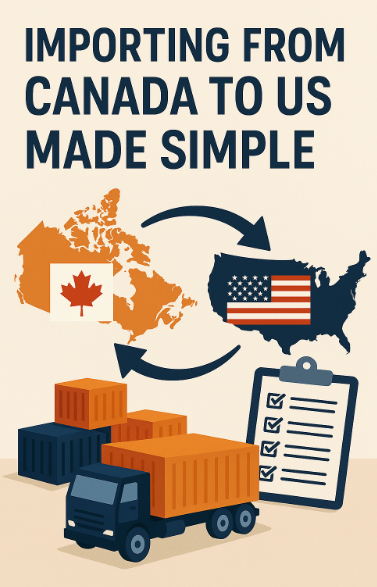
Importing goods from Canada into the United States is one of the most efficient and predictable cross-border trade flows in North America. However, even though the two countries share a long border and extensive trade agreements, many businesses still face delays because of document errors, duty miscalculations, or an unclear understanding of customs requirements. Therefore, this guide breaks everything down step-by-step so growing companies can manage cross-border imports confidently, smoothly, and with fewer surprises.

Why Importing From Canada to the US Matters for Businesses
Because Canada is one of the United States’ largest trading partners, importing from Canada to the US delivers several valuable benefits:
- Short transit times
- Stable, predictable border procedures
- Strong supply chain connectivity
- Lower freight costs compared with overseas imports
- Reduced risk of long-distance damage
- Harmonized trade rules under USMCA
Moreover, US businesses rely heavily on Canadian imports for automotive parts, machinery, raw materials, chemicals, electronics, packaged food, furniture, and industrial supplies. As cross-border demand continues rising, understanding customs requirements becomes crucial for long-term efficiency.
Velotactlcs Logistics supports many businesses across North America by coordinating freight movements, managing customs paperwork, and creating predictable logistical workflows.
What Do You Need to Prepare Before Importing Goods From Canada?
Although importing from Canada is simpler than overseas importing, businesses must still prepare essential documents.
Table 1 — Key Documents Required to Import From Canada to the US
| Document | Purpose |
|---|---|
| Commercial Invoice | Shows product value, seller, buyer, and terms |
| Packing List | Lists cargo details, weight, and packaging |
| Bill of Lading / Trucking BOL | Acts as transportation record |
| Certificate of Origin (USMCA) | Determines duty-free eligibility |
| Customs Bond | Required for cargo above $2,500 |
| Importer ID / EIN Number | Confirms importer identity |
| Commodity HS Code | Determines duty rates |
| Delivery Order | Authorizes cargo release |
| Freight Contract / Booking | Confirms carrier arrangements |
Because correct documentation reduces clearance time, importers should verify accuracy before the shipment departs Canada.
How Does US Customs Clearance Work for Canadian Imports?
Even though importing from Canada is more streamlined, US Customs and Border Protection (CBP) still requires complete and accurate filings.
US Customs Process Overview
- Submit documents to customs broker or CBP
- Verify HS codes and product classification
- Check USMCA eligibility for duty-free treatment
- Issue customs bond (if required)
- File the Entry Summary (CBP Form 7501)
- Pay duties and taxes
- Complete inspection (if selected)
- Receive cargo release and final delivery
Because Canada is part of the USMCA agreement, many goods qualify for duty exemptions as long as the Certificate of Origin is accurate.
What Are the Tax and Duty Rules When Importing From Canada Into the US?
Duty rates depend on the product’s HS code and origin. Fortunately, most Canadian-origin goods qualify for 0% duty.
When Are Duties Charged?
Duties apply when:
- Goods are made outside North America
- Goods do not meet USMCA origin rules
- Goods fall under special duty categories (luxury, textiles, chemicals, etc.)
Common Duty Examples:
| Product Type | Typical Duty Rate |
|---|---|
| Canadian-origin manufactured goods | 0% |
| Electronics | 0–5% |
| Industrial machinery | 0–4% |
| Chemicals | 0–6.5% |
| Furniture | 0–4.5% |
| Textiles | 5–20% |
In addition, importers may pay:
- Merchandise Processing Fee (MPF)
- Harbor Maintenance Fee (HMF) for ocean imports
- State taxes upon sale or use
Therefore, understanding classification early helps avoid surprises.
What Are the Main Transportation Options From Canada to the US?
Because the US-Canada border is well-connected, businesses can choose flexible transport solutions depending on volume, cost, and urgency.
Table 2 — Transportation Methods for Canada-to-US Imports
| Method | Transit Time | Cost Level | Best For | Key Advantages |
|---|---|---|---|---|
| Truck (LTL/FTL) | 1–5 days | Medium | General freight | Fast, reliable, flexible |
| Rail Freight | 3–12 days | Low | Bulk goods | Lower cost, stable for heavy loads |
| Air Freight | 1–3 days | High | Urgent shipments | Fastest delivery |
| Courier/Express | 1–4 days | Medium | Small parcels | Easy customs integration |
| Ocean Freight (East/West Coast routes) | 5–10 days | Low | High volume pallets | Ideal for containerized goods |
Because road transport dominates US-Canada trade, trucking is often the most efficient method for cross-border freight.
Velotactlcs Logistics works with trusted carriers across North America to provide predictable trucking, rail coordination, and expedited transport for time-sensitive shipments.
How Do USMCA Rules Affect Imports From Canada?
USMCA replaced NAFTA and modernized rules of origin, documentation standards, and tariff treatment.
USMCA Benefits:
- Duty-free status for qualifying goods
- Simplified certificate of origin format
- Clearer rules for automotive, agriculture, and industrial goods
- Streamlined customs compliance
- Improved digital documentation
When Does USMCA Not Apply?
- Goods made in Europe or Asia but shipped through Canada
- Goods undergoing insufficient transformation in Canada
- Products missing proper origin certificates
Therefore, businesses must verify origin documents carefully to ensure duty-free eligibility.

What Are the Most Common Errors When Importing From Canada to the US?
Even experienced importers face issues when documentation or compliance steps are missed.
Frequent Problems Include:
- Incorrect HS code classification
- Missing or inaccurate USMCA certificate
- Wrong declared value on invoices
- Missing importer ID / EIN
- No customs bond for imports over $2,500
- Incomplete packing lists
- Carrier errors in Bill of Lading data
Because these errors often delay clearance, working with a professional logistics partner helps prevent costly setbacks.
How Long Does It Take to Import From Canada to the US?
Transit and customs processing times vary depending on route, season, and border traffic.
General Timeline Estimates:
- Document preparation: 1–2 days
- Customs processing: 1–24 hours
- Truck transit: 1–5 days
- Rail transit: 3–12 days
- Air freight: 1–3 days
Therefore, most Canada-to-US shipments clear quickly when documentation is accurate.
How Can Businesses Make Cross-Border Shipping More Efficient?
Efficiency depends on planning. Therefore, businesses should adopt best practices that reduce delays and improve delivery speed.
Best Practices Include:
- Use consistent HS codes across departments
- Confirm USMCA eligibility before shipping
- Maintain complete digital documentation
- Use bonded warehousing when needed
- Work with an experienced customs broker
- Plan shipments to avoid peak border traffic
- Use GPS-enabled trucks for visibility
Additionally, Velotactlcs Logistics provides cross-border workflow optimization, real-time tracking, bonded transport, and customs filing services to ensure reliable delivery schedules.

Conclusion
Therefore, importing from Canada to the US becomes far easier when businesses understand customs requirements, duty rules, transportation options, and documentation standards. Because the US-Canada trade relationship is stable and supported by strong logistics networks, companies that prepare correctly enjoy fast clearance, predictable costs, and smooth supply chain operations.
Moreover, choosing well-planned transport routes, verifying USMCA compliance, and preparing accurate paperwork all help eliminate delays and unexpected expenses. With the right partner, cross-border importing becomes not only manageable but strategically beneficial.
Need a quote?
Ready to get started? Contact us now to request a free shipping quote.
Frequently Asked Questions (FAQ)
You need a customs bond for any shipment valued over $2,500 or if the goods require federal agency review.
They are duty-free only if they meet the origin requirements and include a valid USMCA certificate.
Yes, but items may require FDA, USDA, or APHIS approvals depending on the product type.
Air freight is the fastest, but expedited trucking is usually the best balance of speed and cost.
Classification must follow the Harmonized Tariff Schedule (HTS). A customs expert can help avoid costly misclassification.