
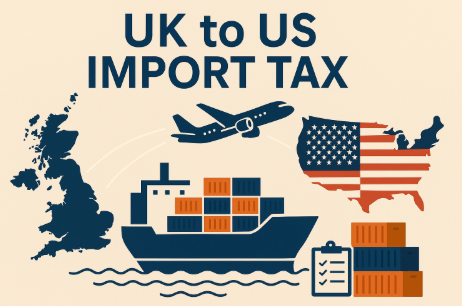
Moving goods from the United Kingdom to the United States becomes much easier when you clearly understand the tax rules, required documents, and customs procedures. Although many importers struggle with tariffs and duties, the process becomes predictable once you know how the UK to US import tax works. Therefore, this guide explains every step so you can minimize delays and control your landed cost confidently.
Because tax rules can feel confusing at first, you will find that understanding duty rates, tariff classifications, and customs paperwork dramatically reduces risk. Moreover, when importers prepare the correct documents early, shipments clear faster and avoid costly storage fees.

What Is the UK to US Import Tax and Why Does It Matter?
Since every shipment entering the United States must be examined by U.S. Customs and Border Protection (CBP), all importers must follow clearly defined rules. The UK to US import tax is not a single charge but a combination of:
- Customs duties
- Merchandise Processing Fee (MPF)
- Harbor Maintenance Fee (HMF, for sea freight only)
- Excise taxes (for specific categories)
- Anti-dumping or countervailing duties (when applicable)
Because each product falls under a specific HTSUS (Harmonized Tariff Schedule of the United States) code, duty rates vary significantly. Therefore, correct classification is essential for accurate cost planning.
In addition, improper classification often leads to customs delays, inspections, or penalty risks. This is why many businesses choose professional logistics partners like Velotactlcs Logistics to handle HTS code evaluation and customs coordination.
How Is UK to US Import Tax Calculated?
Since duties are based on product classification, country of origin, and customs value, CBP calculates tax using a straightforward formula:
Duty = Customs Value × Duty Rate
However, the final landed cost includes other fees:
- MPF: 0.3464% of the cargo value (min $31.67, max $614.35)
- HMF: 0.125% of cargo value (sea freight only)
- Excise Taxes: Alcohol, tobacco, vehicles
- Brokerage Fees: Customs clearance support
Although the UK and USA no longer share EU trade agreements, the UK does not currently have a bilateral FTA with the U.S., so duties remain standard.
What Are the Typical Duty Rates for UK-to-US Imports?
Because duty rates vary from product to product, here is an overview of popular categories imported from the UK.
Table 1: Typical Duty Rates for UK to US Imports
| Product Category | Example Goods | Typical Duty Rate |
|---|---|---|
| Electronics | Phones, devices, components | 0%–6% |
| Automotive | Auto parts, accessories | 2.5%–25% |
| Machinery | Industrial machines, tools | 0%–5% |
| Consumer Goods | Homeware, small appliances | 2%–12% |
| Apparel & Footwear | Clothing, shoes, accessories | 10%–32% |
Because each category includes hundreds of HTS codes, importers should request professional HS classification before shipping.
What Documents Are Required for Smooth Customs Clearance?
Since CBP requires accurate documentation to evaluate duty and compliance, importers must prepare the complete set of paperwork early.
Table 2: Required Customs Documents for UK-to-US Shipments
| Document | Purpose | Provided By |
|---|---|---|
| Commercial Invoice | Declares value & product details | Supplier |
| Packing List | Shows package breakdown | Supplier |
| Bill of Lading / AWB | Confirms transport & carrier info | Carrier |
| ISF (for ocean) | Required 24 hours before loading | Importer/Forwarder |
| HTSUS Classification | Determines tax | Importer |
| Customs Bond | Ensures compliance | Broker/Forwarder |
| Arrival Notice | Confirms arrival | Shipping Line |
Because incorrect documents are the main cause of delays, professional forwarders help verify every detail before cargo departs the UK.
How Do Shipping Modes Affect Total Costs?
Although tax rates do not change by shipping mode, total landed cost changes significantly depending on whether you choose air freight or sea freight.
Table 3: Air Freight vs Sea Freight Comparison
| Mode | Transit Time | Cost Level | Advantages | Best For |
|---|---|---|---|---|
| Air Freight | 2–6 days | High | Fast, secure, low delay risk | High-value or urgent cargo |
| Sea Freight | 12–30 days | Low | Cheaper, ideal for bulk loads | Non-urgent, large shipments |
Because shipping fees often represent a large portion of landed cost, importers should choose modes based on urgency, cargo type, and total budget.
Velotactlcs Logistics helps importers compare options to reduce freight spending and ensure faster clearance upon arrival.
How to Calculate Total Landed Cost for UK to US Imports
Although duties are important, they are only part of the final price. Therefore, importers must calculate the full cost:
Landed Cost = Product Cost + Freight + Duties + MPF + HMF + Brokerage Fees + Domestic Delivery
Because accurate landed cost supports profitable pricing and reduces financial surprises, importers should calculate this value before confirming supplier orders.
Moreover, using a forwarder that provides pre-shipment cost estimation allows you to avoid unexpected charges when cargo reaches the U.S.

How to Classify HTS Codes Correctly
Correct classification ensures accurate import tax. However, misclassification is one of the most common errors.
To classify correctly:
- Review product materials and components
- Understand intended use
- Compare descriptions in HTSUS
- Confirm if special taxes apply
- Request a binding ruling if uncertain
Because classification mistakes can lead to customs holds, importers may choose Velotactlcs Logistics to manage full HS code review and compliance checks.
How to Reduce UK to US Import Tax Legally
Although import tax cannot be fully avoided, importers can reduce overall cost through several legal strategies:
1. First-Sale Valuation
Duty may be based on manufacturer price rather than reseller value.
2. Correct HS Code Optimization
Sometimes a legally correct alternative code carries a lower rate.
3. Multi-Shipment Cost Structuring
MPF caps benefit importers who split shipments smartly.
4. Duty Drawback
Re-exported goods may qualify for up to 99% duty refunds.
5. Mode Optimization
Cheaper routing and consolidation lower overall landed cost.
Because these strategies require experience, working with a qualified logistics provider makes optimization easier and safer.
How Long Does Customs Clearance Take for UK-to-US Imports?
Although clearance times vary by mode and port, average processing times include:
- Air Freight: 1–3 days
- Sea Freight: 2–5 days
- Inspections: Add 1–3 days depending on CBP workload
Since delays mostly come from incorrect paperwork or missing documents, importers should always verify invoices, HS codes, and ISF filings before the shipment leaves the UK.
Why Professional Logistics Support Is Essential
Because customs rules constantly change, importers benefit greatly from expert support. Velotactlcs Logistics provides:
- Accurate HS code classification
- Complete customs documentation preparation
- Duty and tax estimation
- ISF filing support
- Fast clearance coordination
- Shipping route optimization
Additionally, we help you calculate landed cost early and choose the most efficient transport mode based on deadline, budget, and cargo type.
When importers have professional support, they reduce delays, avoid penalties, and maintain predictable delivery schedules.

Conclusion
Understanding UK to US import tax helps importers simplify operations, reduce cost, and avoid customs delays. Moreover, when businesses classify products correctly, prepare accurate documents, and choose the right shipping mode, they keep their supply chain strong and predictable.
If you want expert support with customs, duty calculation, and UK-to-US shipping optimization, Velotactlcs Logistics is ready to assist with reliable and cost-effective logistics solutions tailored to your needs.
Need a quote?
Ready to get started? Contact us now to request a free shipping quote.
Frequently Asked Questions (FAQ)
Shipments under $800 may qualify for Section 321 de minimis entry, but restricted items or high-volume shipments may not qualify. Always verify before shipping.
Yes. The UK is no longer part of the EU, so duty rates depend solely on the HTSUS classification and not EU trade preferences.
CBP may request supplier proof, payment records, or comparable pricing. Accurate invoices prevent revaluation risks.
Refurbished goods often fall under separate HTS codes, which may increase or decrease the duty rate depending on the product.
Yes, but many choose brokers because errors can cause delays or penalties. Professional support reduces risk.