
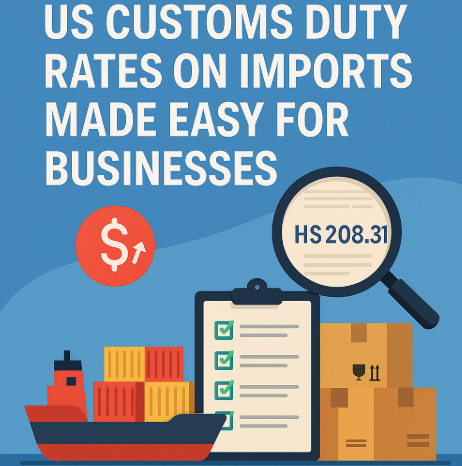
Understanding US customs duty rates on imports is essential for businesses that want to plan costs accurately and avoid unexpected delays. Although the import process may seem complex at first, it becomes significantly easier once you understand how tariff rules, duty calculation, and HS codes work together. Moreover, when companies follow a clear and structured process, customs clearance becomes faster, more predictable, and more cost-effective.
Because duty rates vary by product category, material composition, and country of origin, importers must learn how these details influence landed cost. Therefore, this guide explains everything you need—from HS code classification to duty optimization strategies—to help your business manage imports efficiently and confidently.

What Are US Customs Duty Rates on Imports and Why Do They Matter?
Since every shipment entering the United States must pass through U.S. Customs and Border Protection (CBP), importers must follow strict rules related to duties, taxes, and compliance. The US customs duty rates on imports represent the percentage applied to the declared customs value of goods. These rates ensure fair trade, protect domestic industries, and regulate market competition.
Because each product is classified under a specific HTSUS (Harmonized Tariff Schedule of the United States) code, duty percentages vary widely between product categories. For example, electronics may have low or zero duty, while apparel, machinery, and certain vehicles carry higher tariffs.
Additionally, importers pay several other fees besides basic duty, including the Merchandise Processing Fee (MPF) and Harbor Maintenance Fee (HMF), which directly impact total landed cost. Therefore, businesses must understand these charges early to avoid incorrect budgeting.
How Do HS Codes Determine US Customs Duty Rates on Imports?
Since tariff classification drives almost every customs decision, selecting the correct HS code is the most important step in managing imports. HS codes categorize products globally, and HTSUS codes extend that classification further with additional details specific to US regulations.
To classify accurately, importers must review:
- Material composition
- Intended use
- Manufacturing process
- Product features
- Applicable trade programs
Although suppliers usually provide an HS code, CBP holds the importer responsible for accuracy. Therefore, importers must verify the code carefully before filing customs entries. Moreover, misclassification can cause delays, re-inspections, and penalties.
Because classification is complex, many businesses rely on experienced logistics companies like Velotactlcs Logistics to evaluate HS codes and ensure the correct duty rate is applied.

What Are Typical US Customs Duty Rates on Imports?
Although exact rates depend on HTSUS classification, here is a general reference for common categories.
Table 1: Typical US Customs Duty Rates on Common Imports
| Product Category | Example Goods | Typical Duty Rate |
|---|---|---|
| Electronics | Laptops, cameras, accessories | 0%–6% |
| Apparel | Clothing, textiles | 10%–32% |
| Machinery | Industrial equipment | 0%–5% |
| Furniture | Wood and metal furniture | 0%–8% |
| Automobiles | Passenger vehicles | 2.5% |
| Truck / LCV | Light trucks | 25% |
| Footwear | Shoes, sandals | 10%–37.5% |
Because tariff rates are updated annually, importers must verify the latest HTSUS version before shipping.
How Do You Calculate Total Duty Under US Customs Duty Rates on Imports?
Since duty applies to the customs value, importers use the formula:
Duty = Customs Value × Duty Rate
However, total landed cost includes additional mandatory fees:
- MPF (Merchandise Processing Fee): 0.3464% of value
- HMF (Harbor Maintenance Fee): 0.125% (ocean only)
- Excise taxes for alcohol, tobacco, certain vehicles
- Brokerage fees
- Domestic delivery costs
Because landed cost affects pricing, margins, and procurement planning, businesses should calculate this value before finalizing supplier orders.
Moreover, forwarders like Velotactlcs Logistics can provide an accurate pre-shipment landed-cost estimate to help importers avoid surprises upon arrival.
What Are the Main Documents Needed Under US Customs Duty Rates on Imports?
Since CBP relies heavily on documentation to classify goods and assess duties, importers must prepare accurate paperwork for smooth clearance.
Table 2: Required Documents for Import Clearance
| Document | Purpose | Provided By |
|---|---|---|
| Commercial Invoice | Confirms value and product details | Supplier |
| Packing List | Shows quantity, packaging, weight | Supplier |
| Bill of Lading / AWB | Shipping contract | Carrier |
| Arrival Notice | Confirms cargo availability | Forwarder |
| ISF (for ocean) | Mandatory filing before loading | Importer/Forwarder |
| HTSUS Classification | Determines duty rate | Importer |
| Customs Bond | Guarantees compliance | Broker |
Because incomplete documents cause delays, verifying accuracy before departure is important for smooth clearance.
What Shipping Methods Affect the Total Import Cost?
Although US customs duty rates on imports do not change by transportation mode, freight methods significantly influence total landed cost and delivery speed.
The two most common shipping modes are:
- Air Freight: Fast, higher cost
- Sea Freight: Economical, slower
To help businesses compare, here is a reference table.
Table 3: Air Freight vs Sea Freight for Imports
| Shipping Mode | Transit Time | Cost Level | Advantages | Best For |
|---|---|---|---|---|
| Air Freight | 2–10 days | High | Fast, reliable | High-value or urgent goods |
| Sea Freight | 12–40 days | Low | Cost-effective, suitable for bulk | Heavy or non-urgent shipments |
Because freight cost forms a major portion of landed cost, choosing the right shipping method improves efficiency, budget control, and overall supply chain performance.

How Are Additional Customs Fees Applied?
Besides standard duty, several additional fees apply to imports:
1. MPF (Merchandise Processing Fee)
Applied to all commercial entries, with minimum and maximum charges.
2. HMF (Harbor Maintenance Fee)
Applies only to sea shipments entering US ports.
3. Excise Tax
Applies to certain goods such as alcohol, tobacco, vehicles, tires, and firearms.
4. Anti-dumping and Countervailing Duties (AD/CVD)
Applied when CBP determines products are priced unfairly.
Because AD/CVD rates can exceed 100% in some categories, importers must confirm whether their product falls under any such order.
How to Reduce US Customs Duty Rates on Imports Legally
Although duties cannot be fully avoided, several legal strategies help businesses reduce their total payable amount.
1. First-Sale Rule
Allows duty calculation based on manufacturer value rather than reseller value.
2. Correct Classification
Sometimes a legally valid alternative HTS code has a lower duty rate.
3. De Minimis Entry (Section 321)
Shipments valued under $800 may qualify for duty-free clearance.
4. Splitting Shipments
MPF caps help importers manage high-value shipments more efficiently.
5. Duty Drawback
When goods are re-exported, up to 99% of paid duties may be refunded.
Because each strategy requires compliance knowledge, it is recommended to work with a professional logistics team.
Velotactlcs Logistics helps businesses evaluate classification options, verify documentation, and optimize clearance strategies to reduce overall cost.
What Causes Customs Delays and How to Avoid Them?
Although delays happen for various reasons, common causes include:
- Incorrect HS classification
- Incomplete commercial invoice
- Missing country-of-origin detail
- Low-quality product description
- Wrong declared value
- Late ISF filing
- Port congestion
Therefore, importers should verify all compliance points before shipment departs the exporting country.
Because Velotactlcs Logistics provides pre-clearance document review and ISF filing support, our customers experience smoother and faster import processing.
How Long Does Customs Clearance Take Under US Duty Regulations?
Although clearance varies by port and shipment type, typical processing times include:
- Air freight: 1–3 days
- Sea freight: 2–5 days
- Exam inspection (if selected): +1–3 days
Because CBP may randomly select shipments for inspection, importers should prepare documents accurately to reduce the likelihood of extended review.
Conclusion
US customs duty rates on imports influence total landed cost and affect every importer’s bottom line. Moreover, understanding HS codes, tariff rules, and required documentation helps businesses maintain a stable supply chain and avoid unexpected financial burdens.
If your business wants accurate duty estimation, smooth customs clearance, and cost-optimized logistics solutions, Velotactlcs Logistics provides reliable and professional support for every stage of the import process.
Need a quote?
Ready to get started? Contact us now to request a free shipping quote.
Frequently Asked Questions (FAQ)
You can check the HTSUS database or request a classification review from your logistics provider. Proper classification ensures the correct duty rate and prevents delays.
Yes, HTSUS rates update annually. Reviewing the latest version ensures your product follows current tariff rules.
MPF applies to all commercial shipments, but minimum and maximum charges vary. Air and sea freight pay similar percentages.
Corrections are possible with valid justification. Pre-shipment verification is always better.
Most do, but exceptions exist for restricted or regulated products. Confirm eligibility before shipping.