
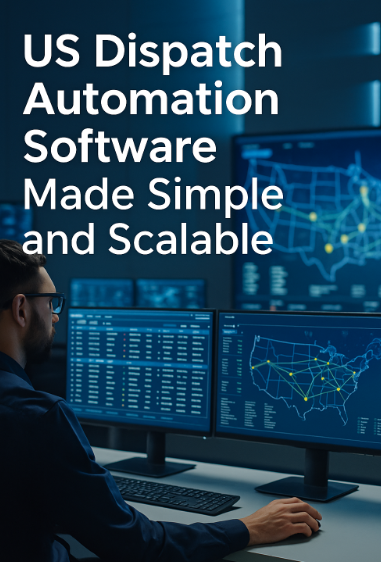
In today’s fast-paced logistics environment, efficiency defines success. Manual dispatching no longer keeps up with growing freight demands, driver shortages, and unpredictable market shifts. This is where US dispatch automation software becomes indispensable — transforming complex dispatch processes into data-driven, real-time solutions that maximize fleet productivity, reduce costs, and enhance delivery accuracy.

What Is US Dispatch Automation Software?
US dispatch automation software is a digital platform that manages freight scheduling, load assignment, and route optimization through artificial intelligence and real-time data. It replaces manual spreadsheets and phone-based coordination with an integrated system that automates dispatch operations, enabling carriers and brokers to scale without increasing administrative costs.
Essentially, it acts as the nerve center of modern freight management — automating communication between shippers, drivers, and dispatchers to ensure timely and profitable delivery cycles.
How Does Dispatch Automation Improve Freight Operations?
Automation eliminates human error and inefficiency from daily logistics tasks. The software automatically matches available trucks with optimal loads, calculates fuel-efficient routes, and monitors driver performance. Moreover, it streamlines billing, invoicing, and load confirmations to minimize paperwork.
Therefore, dispatch automation not only saves time but also increases transparency and reduces costly idle time across the supply chain.
Key Features of US Dispatch Automation Software
The most effective dispatch automation platforms integrate several powerful features to optimize performance and workflow:
- Real-Time Load Matching: Instantly pairs drivers with the most profitable routes.
- Dynamic Route Optimization: Uses live traffic and weather data for accurate ETAs.
- Automated Notifications: Updates shippers, brokers, and drivers automatically.
- Digital Documentation: Handles BOLs, PODs, and invoices electronically.
- Predictive Analytics: Forecasts demand, fuel consumption, and driver utilization.
- Cloud Access: Enables teams to manage logistics remotely and securely.
In addition, leading systems integrate directly with GPS and ELD data, offering full visibility of every shipment in motion.
Comparison: Manual Dispatch vs. Automated Dispatch
| Feature | Manual Dispatch | Automated Dispatch |
|---|---|---|
| Load Matching | Manual phone calls and spreadsheets | AI-driven instant matching |
| Route Planning | Based on static maps | Real-time GPS optimization |
| Communication | Driver calls/texts | Automated alerts and dashboard updates |
| Paperwork | Printed or faxed documents | Digital upload and e-signature |
| Efficiency | Dependent on dispatcher skill | Consistent and data-based |
| Scalability | Limited | Easily scalable across fleets |
Clearly, automation replaces repetitive, error-prone tasks with intelligent workflows that adapt instantly to changing logistics conditions.
Why Is Automation So Critical in US Logistics?
With freight volumes increasing and driver availability shrinking, automation ensures dispatchers can manage more loads with fewer resources. The US dispatch automation software market has expanded rapidly due to its ability to:
- Reduce manual workloads by 50–70%
- Improve route efficiency by up to 20%
- Lower dispatch errors and fuel costs
- Boost customer satisfaction through real-time updates
Furthermore, automation enables logistics companies to make proactive decisions — predicting delivery delays, equipment shortages, or fuel spikes before they impact profitability.
Business Impact of Dispatch Automation
| KPI | Before Automation | After Automation | Improvement |
|---|---|---|---|
| Average Load Assignment Time | 30–45 minutes | 3–5 minutes | 85% faster |
| Fuel Efficiency | 5.5 MPG | 6.8 MPG | +23% |
| On-Time Delivery Rate | 87% | 97% | +10% |
| Paperwork Errors | Frequent | Minimal | -95% |
| Dispatcher-to-Truck Ratio | 1:10 | 1:25 | +150% capacity |
These statistics show how automation transforms dispatch operations from reactive to proactive, saving time and improving profitability.
How Does Dispatch Automation Integrate with Other Systems?
Integration is the cornerstone of modern logistics software. US dispatch automation software can connect seamlessly with Transportation Management Systems (TMS), Warehouse Management Systems (WMS), and accounting tools.
For example:
- Data flows automatically from the TMS into the dispatch dashboard.
- Shipment tracking updates in real time through GPS and IoT sensors.
- Accounting systems receive completed invoices instantly once proof-of-delivery is uploaded.
Therefore, integration eliminates data silos, improves transparency, and ensures every department operates from a single source of truth.

What Technologies Power Dispatch Automation?
Advanced dispatch software relies on several key technologies:
- Artificial Intelligence (AI): Predicts demand and optimizes load assignment.
- Machine Learning: Improves decision-making accuracy over time.
- IoT Tracking: Monitors truck performance and cargo condition.
- Cloud Computing: Enables multi-location collaboration.
- API Connectivity: Syncs with external freight networks and customer systems.
These technologies allow dispatch systems to adapt dynamically, learning from operational data and continuously improving efficiency.
How to Choose the Right US Dispatch Automation Software?
When evaluating automation platforms, logistics businesses should consider:
- Scalability: Can the system handle growth in fleets or routes?
- Customization: Does it support your specific workflow and freight types?
- Integration: Can it connect easily with TMS, CRM, or accounting tools?
- User Experience: Is the interface intuitive for dispatchers and drivers?
- Support & Training: Does the provider offer onboarding assistance and 24/7 help?
A good dispatch automation solution should align with long-term strategic goals while minimizing implementation complexity.
Key Benefits for Different Stakeholders
| Stakeholder | Benefit | Result |
|---|---|---|
| Dispatchers | Simplified workflow | Faster load assignments |
| Drivers | Clear communication | Reduced waiting time |
| Shippers | Transparent updates | Improved service reliability |
| Managers | Real-time analytics | Data-based decision-making |
| Customers | Accurate ETAs | Higher satisfaction |
Therefore, automation benefits every level of the logistics chain, from drivers on the road to executives tracking KPIs.
Conclusion
In a competitive and fast-moving logistics market, US dispatch automation software empowers carriers, brokers, and shippers to do more with less. By automating routing, communication, and paperwork, it transforms traditional dispatching into a precise, scalable, and data-driven operation.
From small fleets to national logistics providers, automation ensures faster deliveries, higher margins, and better visibility across every mile.
Need a quote?
Ready to get started? Contact us now to request a free shipping quote.
Frequently Asked Questions (FAQ)
It’s used to automate freight assignment, routing, and communication between dispatchers, drivers, and clients for greater efficiency.
Yes, modern platforms are scalable and ideal for small fleets aiming to grow without adding administrative overhead.
No. It supports dispatchers by handling repetitive tasks, allowing them to focus on strategy and problem-solving.
Pricing varies by fleet size and features but typically ranges from $500 to $3,000 per month for mid-sized carriers.
Absolutely. Most systems connect seamlessly with ELDs, GPS trackers, and TMS platforms for real-time visibility.