
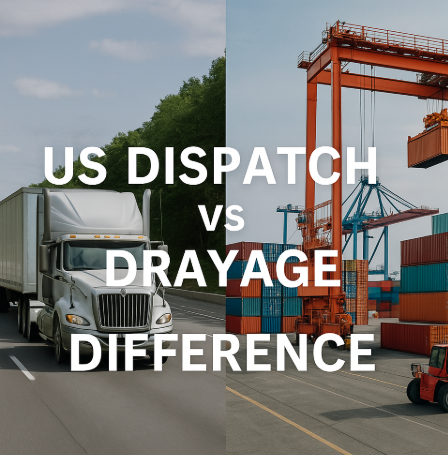
In modern logistics, terms like dispatch and drayage are often used interchangeably, even though they refer to very different processes. Understanding the US dispatch vs drayage difference is essential for shippers, freight forwarders, and carriers looking to optimize costs, timing, and efficiency. While both play a role in moving goods, their functions, timelines, and responsibilities differ significantly.

What Is US Dispatch in Freight Logistics?
US dispatch refers to the coordination, scheduling, and management of freight transport operations. Dispatchers connect shippers with carriers, plan optimal routes, track shipments, and ensure drivers stay on schedule. Essentially, dispatching acts as the communication and control center for freight movement.
In the US, dispatch operations cover both local and long-haul trucking — ensuring loads are booked, picked up, and delivered efficiently. It involves digital tools, GPS tracking, and direct broker-driver communication to minimize downtime and maximize delivery performance.
What Is Drayage in the Shipping Industry?
Drayage is the short-distance transportation of cargo, usually between ports, rail terminals, and nearby warehouses. It forms a crucial part of intermodal logistics, bridging the gap between ocean freight and inland delivery.
For instance, after a container arrives at the Port of Los Angeles, a drayage truck moves it to a regional distribution center for unloading or transloading. Drayage typically covers distances of 30–80 miles and is vital for clearing ports quickly and keeping goods flowing through the supply chain.
Key Difference Between US Dispatch and Drayage
| Feature | US Dispatch | Drayage |
|---|---|---|
| Definition | Scheduling and managing freight routes nationwide | Short-distance transport between ports, terminals, and warehouses |
| Main Role | Coordinates long- and mid-haul trucking | Handles port or rail-to-warehouse delivery |
| Scope | Nationwide | Localized (30–80 miles) |
| Equipment | Dry vans, reefers, flatbeds | Chassis, container trucks |
| Duration | Continuous service | Short-term, one-leg movement |
| Coordination Focus | Driver-route-load management | Container transfer logistics |
In short, dispatch manages the bigger logistics picture, while drayage handles the first or last mile of the freight journey.
How Does Dispatch Work in the US Freight Network?
Dispatching involves three main steps:
- Load Acquisition: Finding freight from brokers or load boards.
- Scheduling & Routing: Assigning drivers and planning optimal paths based on delivery windows.
- Communication & Tracking: Updating clients, managing driver status, and resolving en route issues.
Dispatchers use TMS (Transportation Management Systems) and GPS software to track performance. Therefore, US dispatch ensures that every truck remains productive and every shipment moves efficiently across the country.
How Does Drayage Fit into the Global Supply Chain?
Drayage connects different modes of transport — sea, rail, and truck — within the intermodal framework. Without it, containers would congest ports and delay inland distribution. Drayage providers must coordinate with customs, port authorities, and trucking companies to keep cargo moving seamlessly.
In addition, drayage plays a vital role in e-commerce supply chains. As Amazon and major retailers expand fulfillment networks, drayage ensures goods are transferred from ships or trains to warehouses on tight deadlines.
US Dispatch vs Drayage Operational Comparison
| Function | US Dispatch | Drayage |
|---|---|---|
| Focus | Nationwide load coordination | Port and terminal haulage |
| Time Frame | 1–10 days per load | Same-day or 1–2 days |
| Typical Clients | Freight carriers, brokers, owner-operators | Importers, 3PLs, warehouse operators |
| Regulation | FMCSA and DOT standards | Port authority and customs regulations |
| Tech Usage | Load boards, TMS, ELD tracking | Port appointment and chassis systems |
| Cost Factors | Distance, load weight, route complexity | Port fees, wait times, container return policy |
This comparison shows that dispatching manages multiple stages of transport, while drayage focuses on the most time-sensitive phase — port pickup and delivery.
Why Do Shippers Confuse Dispatch and Drayage?
Both services involve trucking and coordination, but their purposes differ. Confusion arises because drayage can be part of a dispatch-managed operation. For example, a dispatcher might coordinate drayage pickup from the port and assign it to a local carrier.
However, not all dispatch services handle drayage — many specialize in long-haul or regional freight. Therefore, understanding their boundaries helps businesses choose the right partner for each logistics phase.
How Do Costs Differ Between Dispatch and Drayage?
Cost calculation depends on distance, cargo type, and additional fees. Dispatch pricing is often a percentage-based commission (5–10%) per load or a flat service fee for fleet management.
Drayage costs, on the other hand, are typically charged per container, influenced by chassis usage, fuel surcharges, and port congestion.
| Cost Component | Dispatch Services | Drayage Services |
|---|---|---|
| Pricing Model | Percentage per load or monthly retainer | Flat per-container rate |
| Average Cost | $150–$400 per dispatch | $300–$800 per container |
| Extra Charges | ELD, detention, communication fees | Port delays, demurrage, chassis rental |
| Billing Frequency | Weekly or per-load basis | Per trip or per container |
As seen above, drayage often involves unpredictable port costs, while dispatching is more consistent in its pricing structure.
Which Service Impacts Delivery Speed More?
While drayage affects the first leg of transport, dispatch controls the overall supply chain flow. Poor dispatch coordination can delay deliveries nationwide, while inefficient drayage can cause port congestion and longer dwell times.
Therefore, both are equally important — dispatch ensures freight moves smoothly across regions, while drayage prevents bottlenecks at entry points. In combination, they maintain supply chain reliability and timing accuracy.
How Technology Enhances Both Dispatch and Drayage
Technology has revolutionized both fields. Automated dispatch systems now integrate AI for load matching, predictive routing, and driver performance tracking. Meanwhile, drayage uses digital appointment scheduling, real-time container tracking, and port data integration to cut delays.
Moreover, platforms like API-based TMS software allow dispatchers and drayage operators to share data seamlessly, improving visibility across the entire logistics chain.
Conclusion
In summary, the US dispatch vs drayage difference lies in scale, scope, and timing. Dispatch manages the coordination of freight movement across regions, while drayage focuses on local port-to-warehouse transfers. Both are critical to maintaining supply chain efficiency, reducing idle time, and ensuring smooth cargo transitions.
Need a quote?
Ready to get started? Contact us now to request a free shipping quote.
Frequently Asked Questions (FAQ)
Dispatch manages freight scheduling and routing across the country, while drayage handles short-distance transport from ports or terminals.
In some cases, yes. Dispatchers may coordinate drayage loads as part of multimodal freight operations.
Drayage is a short-haul operation, usually completed within the same day or within 24–48 hours.
Yes, some logistics providers offer integrated services that manage both long-haul dispatch and port drayage.
Typical costs range from $300 to $800 per container, depending on port location and congestion fees.