
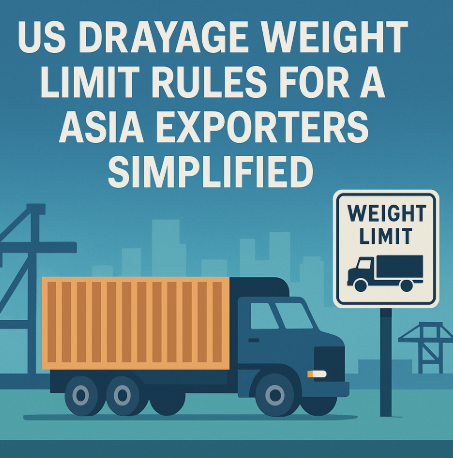
Asia exporters shipping heavy cargo into the United States often struggle with US drayage weight limit rules, especially when container loads approach axle-based trucking restrictions. These regulations directly influence how exporters plan stuffing, manage compliance, and prevent costly delays at major US ports. With the right strategies, businesses can avoid overweight penalties while keeping their supply chains stable and predictable.

What Makes US Drayage Weight Limit Rules Critical for Asia Exporters?
Exporters must understand that US drayage weight restrictions differ from ocean VGM limits and customs requirements. Although ocean freight may accept a heavier total weight, drayage trucks at US ports must comply with federal and state axle laws. Moreover, overweight cargo means rejected pickups, rescheduling delays, and extra chassis fees. Because these issues directly affect ETA accuracy, many Asia exporters rely on Velotactics Logistics for accurate weight planning and compliant routing.
How Do Federal Weight Limit Rules Apply to Drayage Containers?
Although federal law sets the base limit, individual states enforce their own variations. Nevertheless, most drayage trucks follow:
Federal Weight Standards (General Guideline)
| Category | Max Weight |
|---|---|
| GVW (Gross Vehicle Weight) | 80,000 lbs |
| Single Axle | 20,000 lbs |
| Tandem Axle | 34,000 lbs |
| Tridem Axle (where allowed) | 42,000–46,000 lbs |
| Standard 20GP/40GP/40HQ with cargo | Varies by axle + chassis type |
Therefore, even when cargo is legally accepted by shipping lines, the last-mile drayage segment can still reject it if axle distribution exceeds legal limits. Additionally, weigh station enforcement varies by state, requiring exporters to understand regional differences.

Why Do Different US States Have Unique Drayage Weight Limits?
Each state establishes its own rules to protect infrastructure. Consequently, exporters must consider whether their container moves through:
- California (strict axle rules and environmental compliance)
- Texas (heavier allowed on specific permitted roads)
- Georgia (normal limits but high enforcement frequency)
- New York/New Jersey (bridge-based restrictions)
Furthermore, local port terminals may limit maximum gross weight for safe in-yard handling. Consequently, route mapping becomes essential for predicting which states or highways will accept heavier truckloads.
How Should Asia Exporters Calculate Safe Container Loading Weights?
Most drayage carriers prefer the following safe loading ranges:
| Container Type | Safe Cargo Weight | Notes |
|---|---|---|
| 20GP | 19–21 tons | Heavier loads risk axle imbalance |
| 40GP / 40HQ | 19–23 tons | Balanced loading is critical |
| Reefer 40RH | 17–21 tons | Unit weight reduces cargo allowance |
| Flat Rack | Case-by-case | Oversized cargo requires permits |
Additionally, exporters should consider that warehouse forklifts, port cranes, and chassis types impact actual safe handling requirements. Although exporters sometimes load heavier, trucking companies may refuse pickups if cargo exceeds axle limits.
How Do Axle Weight Limits Affect Container Stuffing for Asia Exporters?
Firstly, exporters must understand that axle loads—not total weight—are the root cause of overweight issues. For example:
- Front-heavy cargo increases the chance of tandem axle overweight
- Pallet placement affects weight shift during braking
- Imbalanced cartons create uneven load distribution
- Reefer machinery reduces legal cargo space
Therefore, proper stuffing requires symmetrical placement, center-of-gravity stability, and using lightweight pallets when possible. Additionally, Velotactics Logistics often provides a pre-loading calculation sheet to help clients match stuffing patterns to drayage axle laws.
Should Exporters Use Overweight Permits for Heavier US Drayage Cargo?
Although overweight permits are available in certain regions, they come with limitations:
- Only valid on specific roads
- Not all ports allow overweight departures
- Additional fees apply
- Delays may occur during permit approval
- Some carriers refuse overweight jobs entirely
Therefore, permits should be considered a last resort. Exporters should prioritize smart container loading and early weight verification instead.

How Can Asia Exporters Prevent Drayage Delays Caused by Overweight Loads?
Exporters can significantly reduce delays by following the steps below:
- Request a pre-pickup VGM confirmation from overseas suppliers
- Use balancing charts to ensure weight symmetry
- Avoid placing heavy machines at the container nose
- Consider split shipments if exceeding safe thresholds
- Select reinforced chassis options where available
- Book early with carriers experienced in overweight handling
- Communicate weight details to your freight forwarder before loading
Consequently, these preventive actions reduce port rejections and unnecessary storage charges.
Can Velotactics Logistics Support Heavy or Borderline-Weight Cargo?
Absolutely. Velotactics Logistics provides customized heavy-cargo drayage support through:
- Dedicated overweight-compliant fleets
- Pre-stuffing consulting for Asia exporters
- Real-time terminal appointment scheduling
- Route planning that avoids strict highway limits
- Chassis upgrade availability
- Transparent communication with US truckers
Moreover, exporters shipping machinery, stone, metals, chemicals, and auto parts frequently use Velotactics to keep their supply chain fully compliant.
What Real Case Studies Show How Exporters Manage Drayage Weight Rules?
- Origin–Destination: Qingdao → Port of LA → Inland Empire
- Cargo: CNC machines (19.8 tons)
- Mode: 40HQ
- Cost: USD 3,280 total (ocean + drayage)
- Transit Time: 19 days door-to-warehouse
- Outcome:
After optimizing pallet distribution and shifting machine placement toward the center, axle weight passed inspection, avoiding USD 350 overweight penalties.
- Origin–Destination: HCMC → Port of Savannah → Atlanta
- Cargo: Mixed scrap metal (22 tons)
- Mode: 20GP
- Cost: USD 2,950 total
- Transit Time: 31 days
- Outcome:
Velotactics advised splitting into two lighter loads. Drayage passed weight control, preventing estimated USD 750 fines and 2-day delays.
- Origin–Destination: Shenzhen → NY/NJ → New Jersey
- Cargo: Electronics (17.5 tons)
- Mode: 40HQ
- Cost: USD 3,650
- Transit Time: 28 days
- Outcome:
Although within limits, the container required front-to-back balancing to meet tandem axle restrictions. Delivery completed without inspection stops.
What Loading Strategies Help Exporters Avoid Overweight Problems?
Exporters shipping heavy cargo should:
- Use spread loading instead of concentrated stacking
- Place dense goods toward the rear third of the container
- Avoid placing engines or solid metal at the nose
- Use lightweight pallets or no pallets if safe
- Add shock-absorbing padding to stabilize shifting cargo
Additionally, planning early with your logistics provider simplifies compliance during peak shipping seasons.
Why Should Asia Exporters Consider Working with Specialized Drayage Providers?
Experienced drayage providers offer compliance advantages such as real-time weight verification, overweight-skill drivers, and dedicated heavy-load fleets. Because inexperienced providers often reject last-minute overweight cargo, exporters who rely on Velotactics Logistics enjoy smoother operations, predictable ETAs, and fewer unexpected penalties.
Conclusion
US drayage weight limit rules for Asia exporters may seem complicated, but proper planning ensures fully compliant trucking, predictable cargo flow, and zero penalty risk. Moreover, exporters can avoid overweight rejections by calculating safe stuffing weights, balancing cargo carefully, and collaborating with a knowledgeable partner. To maintain smooth supply chains and achieve cost efficiency, Asia exporters should always confirm US drayage limits during booking and loading.
Need a quote?
Ready to get started? Contact us now to request a free shipping quote.
Frequently Asked Questions (FAQ)
Overweight loads may be refused by truckers, fined at weigh stations, or sent back to the terminal for reworking.
Yes. Ocean VGM rules differ from axle-based trucking laws, so exporters must check both separately.
Permits exist but apply only on limited roads, add fees, and do not guarantee carrier acceptance.
Balanced stuffing, pre-loading weight checks, and communicating exact cargo weights with your forwarder help prevent issues.
Their short wheelbase causes heavier axle pressure, making imbalanced cargo more sensitive to legal limits.