
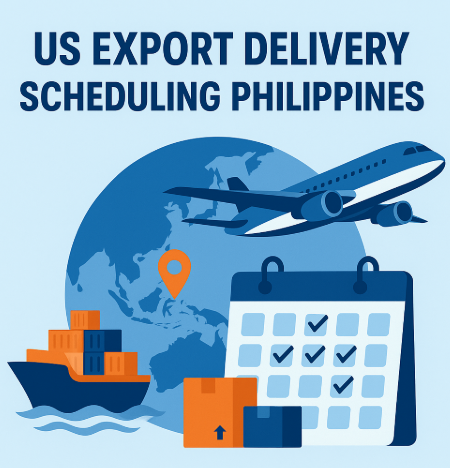
US exporters shipping to the Philippines increasingly need faster coordination, predictable timelines, and strong supply-chain visibility. Because delivery timing directly affects production cycles, inventory planning, and customer satisfaction, a structured approach to US export delivery scheduling Philippines has become essential. Although many exporters face delays due to customs bottlenecks, routing changes, or communication gaps, the right scheduling strategy provides clarity, speed, and control over every shipment.

What Does US Export Delivery Scheduling to the Philippines Involve?
Effective delivery scheduling covers the entire door-to-port or door-to-door journey. Moreover, strong coordination ensures that every milestone—from booking to port handover—follows a clear timeline. Accurate US export delivery scheduling Philippines includes:
- Booking vessel or air freight space
- Pickup and drayage planning
- Export customs filing and clearance
- Cut-off time coordination
- Vessel ETD/ETA monitoring
- Transshipment and diversion tracking
- Import and delivery timing within the Philippines
Furthermore, structured scheduling reduces risks such as rolled containers, incorrect documentation, or missed cut-off windows.
How Do Shipping Modes Affect US Export Delivery Scheduling for the Philippines?
Transport mode affects both cost and transit time. Additionally, each method carries different scheduling advantages and limitations.
Table 1 — Freight Mode Comparison (Cost & Time)
| Mode | Avg. Cost | Transit Time (US → PH) | Best For | Notes |
|---|---|---|---|---|
| Ocean FCL | Low–Medium | 22–32 days | High-volume cargo | Predictable for weekly sailings |
| Ocean LCL | Medium | 28–45 days | Smaller shipments | Requires consolidation time |
| Air Freight | High | 3–6 days | Urgent or high-value items | Most reliable for tight schedules |
| Express Courier | Highest | 2–4 days | Samples & small parcels | Premium but fastest |
Although air and express offer speed, ocean freight remains the most cost-effective choice for consistent export cycles.

Why Is Delivery Scheduling Crucial for the Philippines Market?
Because the Philippines consists of more than 7,000 islands, inland distribution requires careful timing. Furthermore, importers rely on synchronized delivery to support retail cycles, manufacturing lines, and warehouse operations.
Strong scheduling improves:
- Inventory accuracy
- Production continuity
- Last-mile delivery efficiency
- Importer satisfaction
- Risk mitigation
Since delays cascade quickly in island-based supply chains, exporters receive major benefits by aligning shipment timing with the consignee’s internal logistics calendar.
How Do Cut-Off Times Influence US Export Delivery Scheduling to the Philippines?
Cut-off times determine whether a shipment will load onto a planned vessel or be pushed to the next week. Additionally, exporters must coordinate documentation, pickup, packing, and submission deadlines.
Common Cut-Off Windows
- VGM cut-off: 24–48 hours before vessel loading
- CY cut-off: 1–3 days before ETD
- Documentation cut-off: 24 hours before CY closing
- AES filing: Before container gate-in
Velotactlcs Logistics provides cut-off reminders and real-time adjustments to prevent delays and missed vessel schedules.
What Documents Affect Delivery Scheduling for US-to-Philippines Exports?
Proper documentation ensures smooth customs clearance and accurate delivery sequencing.
Table 2 — Key Export Documents
| Document | Purpose | Scheduling Impact |
|---|---|---|
| Commercial Invoice | Value declaration | Delays if incorrect |
| Packing List | Cargo breakdown | Needed for release |
| Bill of Lading | Transport contract | Must match cargo |
| AES Filing | Export declaration | Required before gate-in |
| Certificate of Origin | Duty benefits | Optional but important |
| MSDS | Required for hazmat | Delays without approval |
Although Philippine customs is generally efficient, incomplete documentation can delay release and delivery by several days.
What Transit Times Should Exporters Expect for US–Philippines Shipments?
Transit time varies by origin port and carrier route. Additionally, ocean freight often includes transshipment via Singapore, Hong Kong, or Taiwan.
Table 3 — Estimated Transit Time (US → Philippines)
| Origin Port | ETA Manila | ETA Cebu | ETA Davao |
|---|---|---|---|
| Los Angeles / Long Beach | 22–28 days | 26–32 days | 28–34 days |
| Houston | 28–35 days | 33–40 days | 35–42 days |
| New York | 34–42 days | 38–46 days | 40–48 days |
Air freight times range between 3–6 days, making it ideal for urgent deliveries, high-value goods, or product launches.
How Should Exporters Align US Export Delivery Scheduling With Philippine Import Workflows?
Delivery timing must match the importer’s internal processes. Moreover, strong coordination prevents congestion at warehouses, unnecessary storage fees, or delays in production.
Recommended practices include:
- Aligning ETA with warehouse capacity
- Pre-alerting importers before arrival
- Preparing arrival notice documentation early
- Scheduling trucking in advance for Manila/Cebu/Davao
- Avoiding peak Philippine port congestion periods
Velotactlcs Logistics assists by aligning delivery with importer readiness, ensuring smoother end-to-end execution.
Why Should US Exporters Use a Professional Logistics Partner for Delivery Scheduling?
Professional partners provide structure, speed, and visibility. Moreover, they eliminate administrative bottlenecks that disrupt delivery timing.
Velotactlcs Logistics offers:
- Weekly sailing schedules
- Carrier space allocation
- Cut-off management
- Export filing support
- Tracking & milestone notifications
- Air/ocean transit comparison
- Coordination for Philippine last-mile delivery
Although exporters can schedule shipments on their own, a logistics partner improves accuracy and reduces avoidable delays.
Real Case Studies — Successful Delivery Scheduling for the Philippines
- Origin: Los Angeles
- Destination: Manila
- Cargo: 40HQ electronics
- Cost: USD 2,150
- Transit: 27 days
- Outcome: Velotactlcs Logistics coordinated early cut-off compliance and secured stable vessel space during a peak season rush, ensuring on-time store distribution.
- Origin: Chicago
- Destination: Cebu
- Weight: 860 kg
- Transit: 4 days
- Cost: USD 5,900
- Outcome: The importer needed fast replenishment. Air freight allowed immediate customs release, enabling uninterrupted e-commerce sales.
- Origin: Houston
- Destination: Davao
- Volume: 6.2 CBM
- Transit: 36 days
- Cost: USD 920
- Outcome: LCL routing reduced cost while Velotactlcs ensured transparent milestone tracking, preventing confusion across multiple depots.

Conclusion
Strong US export delivery scheduling Philippines practices ensure reliable transit time, efficient customs clearance, and smooth last-mile distribution. Because delivery timing directly impacts customer satisfaction and supply-chain stability, exporters benefit from structured planning and professional logistics support. Velotactlcs Logistics helps US businesses gain predictable timelines, clearer coordination, and stress-free export execution for every Philippine shipment.
Need a quote?
Ready to get started? Contact us now to request a free shipping quote.
Frequently Asked Questions (FAQ)
Exporters benefit from scheduling at least 7–10 days before CY cut-off, ensuring enough time for pickup, documentation, and customs filing.
Changes are possible but depend on carrier space and cut-off rules; early communication improves success rates.
Manila experiences periodic congestion, so exporters should monitor updates and book earlier during peak seasons.
Air freight is ideal for urgent shipments due to faster transit, predictable slots, and quick customs clearance.
Incorrect documents, late AES filing, missed cut-offs, or transshipment delays often affect timelines.