
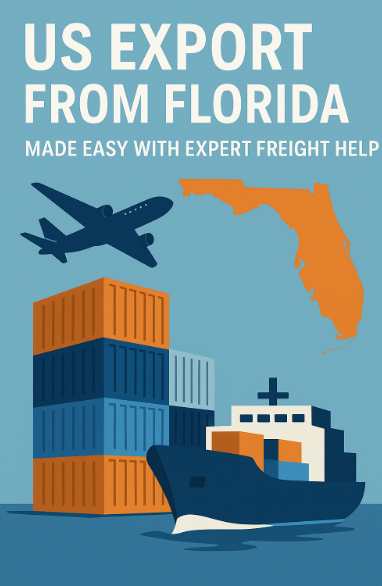
Florida stands as one of the most strategic export hubs in the United States, linking America to Latin America, Europe, and Africa. US export from Florida is not just about geography — it’s about efficiency, global reach, and smart logistics planning. With expert guidance from Velotac, exporters can simplify shipping processes, control costs, and ensure their goods reach international buyers safely and on schedule.

Why Is Florida a Key Export Hub in the United States?
Florida’s geographic advantage, modern infrastructure, and global port connections make it a leader in American exports. With 15 deepwater seaports, including Miami, Jacksonville, and Tampa Bay, the state provides direct access to more than 140 countries. In addition, its international airports like Miami International (MIA) and Orlando International handle significant cargo traffic to Europe, Africa, and Latin America.
Florida also benefits from strong logistics ecosystems and free trade zones, giving businesses lower tariffs, faster clearance, and better inventory control. Therefore, exporters from Florida enjoy more competitive delivery schedules and reduced costs.
What Are the Main Products in US Export from Florida?
Florida’s exports are diverse, ranging from high-tech equipment to agricultural goods. The following table summarizes the top export categories and destinations:
| Product Category | Main Products | Key Destinations |
|---|---|---|
| Aerospace & Machinery | Aircraft parts, engines, turbines | Brazil, UK, UAE |
| Agriculture & Food | Citrus fruits, seafood, grains | Canada, Netherlands, Japan |
| Medical Equipment | Diagnostic tools, implants, devices | Germany, Colombia, Nigeria |
| Automotive & Parts | Cars, spare parts, marine engines | Mexico, Chile, Spain |
| Electronics & Tech | Semiconductors, telecommunication gear | France, South Africa, India |
This variety highlights Florida’s flexibility in handling exports across industries — whether it’s perishable goods requiring refrigeration or machinery needing specialized packing.
How to Choose the Best Shipping Method from Florida
Choosing the right transport mode depends on cargo size, destination, and urgency. Below is a comparison of common freight methods used for US export from Florida:
| Shipping Mode | Average Cost (per kg) | Transit Time | Best Suited For |
|---|---|---|---|
| Air Freight | $4–$7 | 5–9 days | High-value, time-sensitive |
| Sea Freight | $1–$2 | 20–35 days | Bulky, heavy, non-urgent |
| Express Courier | $6–$12 | 3–5 days | Samples, small electronics |
Air freight is ideal for medical or electronic items, while sea freight works best for agricultural or construction machinery. Velotac provides combined shipping solutions, helping exporters balance cost and delivery time efficiently.
How to Handle Customs for US Export from Florida
Exporters must prepare complete and accurate documentation to avoid clearance delays. The essential documents typically include:
| Document Name | Description / Purpose |
|---|---|
| Commercial Invoice | Details goods, value, and buyer information |
| Packing List | Specifies contents and packaging details |
| Certificate of Origin | Confirms goods manufactured in the US |
| Bill of Lading / Air Waybill | Proof of shipment issued by the carrier |
| Export License (if required) | Authorizes restricted goods |
Each importing country may have additional rules, such as phytosanitary certificates for food or conformity assessments for electronics. Velotac’s customs team ensures compliance with both US and foreign import standards, reducing risk and saving time.
What Are the Main Ports for US Export from Florida?
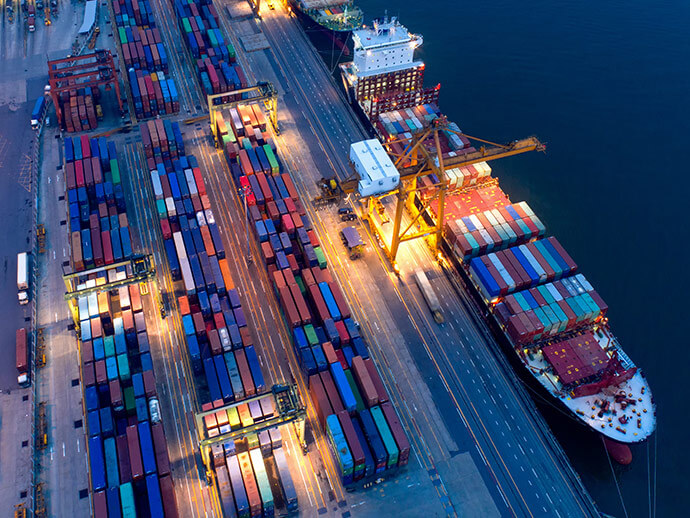
Florida’s ports are among the most advanced in the US, supporting all types of freight:
- Port of Miami: Gateway to Latin America and the Caribbean; ideal for consumer goods and perishables.
- Port Everglades: Specializes in containerized goods and fuel exports.
- Port of Jacksonville (JAXPORT): Handles vehicles, machinery, and large-scale industrial cargo.
- Port Tampa Bay: Ideal for bulk cargo and agricultural commodities.
In addition, Florida’s inland logistics network provides seamless road and rail connections to neighboring states, ensuring rapid cargo movement from warehouses to ports.
Case Studies: Real Export Success Stories from Florida
- Medical Devices to Germany: A Miami-based manufacturer exported precision diagnostic tools to Europe via air freight. Velotac handled customs clearance, ensuring FDA documentation matched EU import requirements. Delivery completed within one week.
- Agricultural Produce to Japan: A citrus exporter from Fort Myers shipped refrigerated oranges using sea freight. Velotac coordinated cold-chain logistics, keeping the shipment fresh during the 28-day voyage.
- Machinery to South Africa: A Florida engineering firm exported turbine components to Cape Town. Velotac arranged multi-modal shipping (sea + air), cutting overall transit time by 20%.
These examples show how professional logistics planning directly enhances export performance and profitability.
How to Calculate Export Costs from Florida
Understanding export costs helps businesses plan pricing and logistics budgets effectively. Typical cost breakdowns include:
- Freight charges: Based on cargo weight and shipping mode.
- Handling fees: For packaging, loading, and warehousing.
- Insurance: 1–2% of declared cargo value.
- Customs & documentation: Approximately 5–10% of invoice value.
For example, exporting machinery by sea from Miami to Lagos might cost around $2,800 per 20ft container, while air freight for 500 kg of electronics to Dubai could range from $3,500–$4,000. Velotac offers transparent quotations so exporters can manage budgets without hidden fees.

How Trade Regulations Influence US Export from Florida
Exporters must comply with US export controls and international trade laws. Certain items—like electronics, chemicals, and defense-related equipment—may require a special export license from the Bureau of Industry and Security (BIS).
Additionally, importers in other countries may request certificates of conformity or inspection reports. Velotac’s compliance department helps businesses verify all licensing and regulatory needs before shipment, preventing costly rejections.
How Florida Businesses Benefit from Free Trade Agreements
Florida-based exporters enjoy access to several trade agreements that reduce tariffs and boost competitiveness:
- USMCA (United States–Mexico–Canada Agreement) for North American trade.
- CAFTA-DR (Central America–Dominican Republic Free Trade Agreement) for Latin markets.
- AGOA (African Growth and Opportunity Act) promoting trade with Africa.
Leveraging these agreements can help Florida exporters save thousands in duties and streamline market entry. Velotac provides tailored support to help clients identify which agreement applies to their products.
Why Work with Velotac for Florida Export Operations
Velotac offers an integrated logistics service for businesses exporting from Florida to the world. From documentation to cargo handling, our team ensures compliance, reliability, and speed. With an extensive partner network across ports, airports, and customs offices, Velotac makes global trade smoother for both small businesses and large enterprises.
Whether it’s full container loads, air freight, or temperature-controlled shipments, Velotac provides cost-effective, end-to-end solutions for every exporter.
Conclusion
In conclusion, US export from Florida remains a cornerstone of America’s international trade strength. With strategic seaports, advanced infrastructure, and reliable freight support from Velotac, exporters can achieve faster delivery, lower costs, and stronger global partnerships. Florida’s position as a logistics hub ensures that businesses — large or small — can connect with international markets seamlessly and confidently.
Need a quote?
Ready to get started? Contact us now to request a free shipping quote.
Frequently Asked Questions (FAQ)
Sea freight usually takes 20–30 days, while air freight delivers within 5–8 days, depending on customs efficiency and route.
You need a commercial invoice, packing list, certificate of origin, and bill of lading. Some goods also require an export license.
Port of Miami and Port Tampa Bay are top choices for perishable or refrigerated agricultural goods.
Yes. With Velotac’s LCL (less than container load) and air freight services, even small exporters can reach global markets efficiently.
Combine cargo weight, shipping method, insurance, and handling fees. Velotac provides transparent cost estimates for every route.