
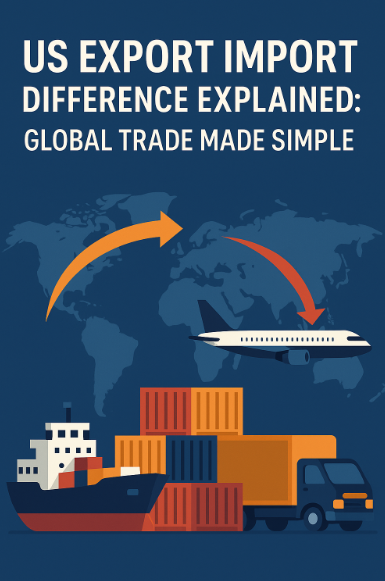
Global trade keeps the world moving. Every day, trillions of dollars’ worth of goods are exported and imported across borders. Yet, many business owners struggle to understand the core difference between export and import, how trade balance works, and what factors affect cross-border logistics. In this comprehensive guide, we break down the US export import difference with real data, practical examples, and insights from Velotac Logistics — helping you navigate international shipping confidently.

What Is the Real Difference Between Export and Import?
The terms export and import define two opposite sides of global trade.
- Exports are goods or services sold by a country to foreign markets.
- Imports are goods or services purchased from abroad for domestic use.
From the U.S. perspective, exporting generates revenue and supports jobs, while importing ensures supply for industries and consumers. The balance between these two determines a country’s trade health, known as the trade balance.
For example, when the U.S. sells agricultural machinery to Canada, it’s an export; when it buys electronics from Japan, it’s an import. Understanding this difference is crucial for businesses engaged in cross-border trade.
How Does the Trade Balance Reflect US Economic Strength?
The trade balance measures the gap between export and import values.
| Trade Term | Description | Economic Meaning |
|---|---|---|
| Trade Surplus | Exports > Imports | Indicates a strong export sector and global demand |
| Trade Deficit | Imports > Exports | Suggests higher domestic demand or production gaps |
| Balanced Trade | Exports ≈ Imports | Reflects stable international exchange |
The U.S. typically runs a trade deficit, meaning it imports more than it exports. In 2024, U.S. exports totaled about $2.7 trillion, while imports reached $3.9 trillion, resulting in a trade deficit of $1.2 trillion. Despite that, strong service exports and innovation in logistics, technology, and manufacturing keep America a major global trade hub.
Why Do Countries Need Both Exports and Imports?
Although a trade surplus is often seen as positive, imports are equally important.
Exports bring in foreign income, but imports allow countries to access advanced technologies, cheaper materials, and diverse goods.
Here’s how exports and imports support each other:
| Function | Exports | Imports |
|---|---|---|
| Economic Growth | Increases national income | Expands consumer choice |
| Industrial Supply | Opens new markets for producers | Provides raw materials |
| Price Stability | Reduces production surplus | Keeps domestic prices competitive |
| Innovation | Promotes technological transfer abroad | Introduces foreign technology |
Therefore, balanced participation in both export and import activities strengthens a nation’s economy and supply chain resilience.
What Are the Main US Export Categories?
The United States exports a diverse range of goods and services. In 2025, manufacturing, energy, and high-tech products lead the way. According to the U.S. International Trade Administration (ITA), here are the top U.S. export categories:
| Category | 2025 Export Value (USD Billion) | Growth vs. 2024 | Share of Total Exports |
|---|---|---|---|
| Industrial Machinery & Equipment | 420 | +6.5% | 15% |
| Energy (Oil, LNG, Coal) | 360 | +8.9% | 13% |
| Vehicles & Auto Parts | 340 | +7.2% | 12% |
| Electronics & Semiconductors | 295 | +5.8% | 10% |
| Agricultural Products | 210 | +4.3% | 8% |
| Aerospace Components | 175 | +5.1% | 6% |
These exports are distributed globally, with Mexico, Canada, China, and Japan as the top destinations. Such diversity protects the U.S. economy from regional disruptions and supports over 10 million export-related jobs nationwide.
What Are the Major US Imports and Why Do They Matter?
Imports are essential to maintaining America’s competitive edge. They provide access to affordable consumer products, advanced materials, and parts required for manufacturing. The U.S. imports primarily from China, Mexico, Canada, Germany, and South Korea.
| Product Category | 2025 Import Value (USD Billion) | Main Source Countries |
|---|---|---|
| Electronics & Computers | 540 | China, Vietnam, Taiwan |
| Vehicles & Auto Parts | 480 | Japan, Mexico, Germany |
| Pharmaceuticals | 270 | Ireland, Switzerland, India |
| Machinery | 265 | Germany, China, Italy |
| Apparel & Textiles | 145 | Bangladesh, Vietnam, India |
Therefore, while exports drive revenue, imports help sustain domestic industries and ensure product availability at competitive prices.
How Does Freight and Logistics Affect Trade Flow?
Efficient logistics is the backbone of international trade. Every export or import transaction involves transport, documentation, and customs procedures.
The U.S. relies on multiple transport modes, depending on cargo type and destination:
| Mode of Transport | Share of Total US Trade | Average Transit Time | Primary Usage |
|---|---|---|---|
| Sea Freight | 67% | 20–35 days | Heavy or bulk cargo |
| Air Freight | 21% | 2–7 days | High-value or urgent goods |
| Truck Freight | 10% | 1–5 days | Cross-border trade with Mexico/Canada |
| Rail Freight | 2% | 3–10 days | Inland transport or intermodal trade |
Velotac Logistics specializes in combining these modes for efficiency. By using multimodal transport, real-time tracking, and digital customs processing, exporters and importers can reduce costs while ensuring faster delivery schedules.
What Role Does Customs Clearance Play in Exports and Imports?
Customs is the regulatory gateway between countries. Every product entering or leaving the U.S. must meet customs requirements, including proper classification, valuation, and documentation.
Export Clearance:
- Requires electronic filing via AES (Automated Export System).
- Needs accurate Harmonized System (HS) codes.
- Must comply with export control regulations under the BIS (Bureau of Industry and Security).
Import Clearance:
- Managed by U.S. Customs and Border Protection (CBP).
- Involves duty payments, inspection, and compliance with trade laws.
- Requires customs bonds for commercial shipments.
Velotac Logistics provides end-to-end customs solutions to help businesses handle compliance smoothly, preventing costly delays and penalties.
How Does Trade Balance Affect Global Logistics?
The U.S. trade deficit means more goods enter the country than leave it, creating equipment imbalances in logistics. For instance, containers arrive full but often return empty. This affects freight pricing and availability.
However, increasing export volumes in sectors like agriculture, renewable energy, and manufacturing are helping rebalance trade flows. Logistics providers such as Velotac Logistics use predictive analytics and regional routing to manage container repositioning and ensure steady supply chain performance.
Why Is Understanding Export-Import Balance Vital for Businesses?
Knowing how exports and imports interact helps companies plan production, manage inventory, and forecast costs. Exporters benefit from government incentives, while importers gain from diversified sourcing.
For businesses aiming to expand globally:
- Analyze trade patterns to identify growing demand regions.
- Understand shipping and customs regulations in target markets.
- Partner with professional freight forwarders to manage transport complexity.
Velotac Logistics offers these integrated solutions, connecting U.S. businesses to markets worldwide through optimized shipping, customs clearance, and documentation management.
What Future Trends Will Shape the US Export-Import Landscape?
The coming years will bring rapid change to global trade. Some emerging trends include:
- Nearshoring: More U.S. companies are shifting production closer to home, especially in Mexico.
- Digital Logistics: AI, blockchain, and predictive shipping are reshaping supply chains.
- Green Shipping: Low-emission fleets and carbon-neutral routes are becoming industry standards.
- E-commerce Exports: Direct-to-consumer exports from the U.S. are expanding rapidly.
Therefore, staying updated on these developments is critical to maintaining a competitive advantage in international markets.
Conclusion
Understanding the US export import difference is essential for any company involved in global trade. Exports fuel national income, while imports sustain industrial growth and consumer access. Balancing both ensures economic stability and international cooperation.
With professional logistics partners like Velotac Logistics, businesses can manage cross-border operations with confidence — ensuring every shipment is fast, compliant, and cost-efficient in the ever-evolving world of international trade.
Need a quote?
Ready to get started? Contact us now to request a free shipping quote.
Frequently Asked Questions (FAQ)
Exports are goods sold abroad, while imports are goods purchased from other countries for domestic use.
The U.S. imports more consumer goods and industrial inputs than it exports, creating a trade gap that reflects strong domestic demand.
Higher shipping or customs costs can reduce profit margins, making efficient logistics management essential for competitiveness.
Common export documents include a commercial invoice, packing list, bill of lading, and certificate of origin.
Yes. With digital logistics services and trade financing, small firms can compete globally with proper guidance and support.