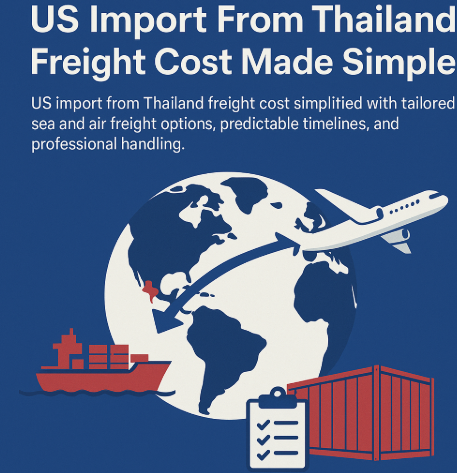
US import from Thailand freight cost has become a key topic for importers seeking predictable logistics performance, competitive rates, and smooth cross-border operations. As Thailand strengthens its role as a manufacturing and export hub for automotive parts, electronics, furniture, clothing, and food products, American businesses increasingly look for reliable freight solutions that balance cost, transit time, and compliance. With the right professional support, importers can optimize their Thailand–USA supply chain and minimize unnecessary expenses.
What Drives US Import From Thailand Freight Cost Today?
Several factors influence total freight cost, including shipping mode, cargo characteristics, destination port, market demand, and carrier availability. Moreover, freight rates continue to fluctuate due to fuel prices, seasonal demand, and global supply-chain conditions. Therefore, understanding cost components helps importers plan more effectively.
Long-tail keywords included naturally: Thailand to USA shipping cost, Thailand export freight rates, Thailand air cargo pricing, Bangkok to USA transit time, Thailand container shipping rate.
How Does Shipping From Thailand to the USA Work?
The shipping process typically involves supplier confirmation, cargo inspection, packing, customs clearance, freight booking, and US port handling. Although Thailand has multiple export gateways, Bangkok Port and Laem Chabang remain the primary hubs for both sea and air freight.
Additionally, choosing the right port, carrier, and transit schedule significantly impacts total freight cost and delivery reliability.
Which Shipping Methods Affect US Import From Thailand Freight Cost Most?
Here is a detailed comparison importers can use to plan shipments:
Mode
Cost
Transit Time
Best For
Pros
Cons
FCL Sea Freight
Medium
22–32 days
Bulk cargo
Stable rates, secure
Slower
LCL Sea Freight
Low
26–38 days
Small shipments
Cost-efficient
More handling
Air Freight
High
4–8 days
Urgent goods
Fast & reliable
Expensive
Express Courier
Highest
2–5 days
Samples, small items
Quickest
High per-kg cost
Because each mode offers unique advantages, importers often combine sea and air options depending on inventory cycles.
Why Do Importers Choose Thailand for Manufacturing and Trade?
Thailand is known for its manufacturing strength in electronics, automotive parts, rubber products, plastics, furniture, food processing, and textiles. Furthermore, businesses benefit from:
Competitive factory pricing
Strong export efficiency
High product quality consistency
Modern logistics infrastructure
Stable supply chain networks
Lower operational risk compared to some regional markets
Therefore, Thailand offers a balanced sourcing ecosystem for both SMEs and large enterprises.
What Documents Are Required for US Import From Thailand?
Accurate documentation plays a major role in ensuring smooth customs clearance. Here is a helpful checklist:
Document
Purpose
Commercial Invoice
Declares product value
Packing List
Confirms quantities & packaging
Certificate of Origin
Determines duty
Bill of Lading / Air Waybill
Transportation record
HS Code Sheet
Classification rules
ISF Filing Data
Required for ocean shipments
Compliance Docs
FDA, USDA, FCC, etc.
Velotactlcs Logistics pre-checks all documentation to minimize customs delays and unexpected penalties.
How Much Does It Cost to Ship Cargo From Thailand to the USA?
Freight cost depends on volume, weight, destination, carrier, and season. Typical market prices include:
FCL 40HQ: $2,100–$3,650
LCL: $35–$70 per CBM
Air Freight: $3.9–$7.2 per kg
Express: $6–$13 per kg
Although rates fluctuate weekly, professional forwarders help importers secure stable, long-term pricing agreements.
How Do Transit Times Influence US Import From Thailand Freight Cost?
Transit times vary based on port selection, carrier routing, and seasonal conditions:
Route
Transit Time
Notes
Bangkok → Los Angeles
22–27 days
Fastest sea route
Laem Chabang → Houston
26–33 days
Stable transit
Bangkok → New York
29–38 days
Longer distance
Air Freight (All)
4–8 days
Fastest option
Because faster transit often means higher cost, companies balance time sensitivity with budget constraints.
How Velotactlcs Logistics Helps Reduce Freight Cost From Thailand
Because our Thailand–USA lane specialists understand local regulations and freight market conditions, we help importers avoid avoidable delays and cost overruns.
How to Reduce US Import From Thailand Freight Cost?
Importers can reduce spending by:
Consolidating small shipments
Booking early for peak seasons
Selecting stable carriers
Using FCL when volume grows
Ensuring correct HS codes
Avoiding unnecessary port fees
Optimizing delivery schedules
Additionally, long-term rate agreements with forwarders provide predictable budgeting.
How to Avoid Delays in Thailand–USA Shipping?
To prevent delays, importers should:
Keep documents accurate and complete
Follow packaging guidelines
Avoid misclassified HS codes
Confirm export readiness early
Use compliance checks for sensitive goods
Choose origin ports with reliable handling
Professional logistics support adds consistency and reduces shipment risk significantly.
Conclusion
US import from Thailand freight cost depends on shipping mode, cargo volume, documentation accuracy, and market conditions. With clear planning and reliable professional handling, importers can reduce overall logistics costs while improving delivery predictability. Velotactlcs Logistics supports your Thailand–USA supply chain with optimized freight options, accurate compliance, and dependable transit schedules. For businesses seeking a stable and cost-effective strategy, Thailand remains a competitive sourcing destination with excellent logistics potential.
Need a quote?
Ready to get started? Contact us now to request a free shipping quote.