
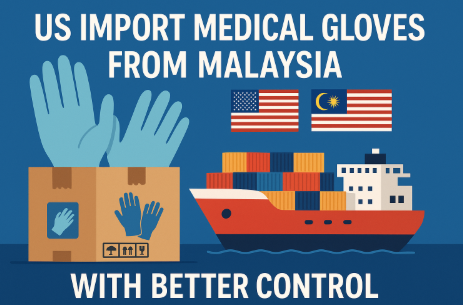
US import medical gloves from Malaysia continues to grow as hospitals, distributors, and medical supply companies prioritize high-quality latex, nitrile, and vinyl gloves from one of the world’s largest and most reliable manufacturing hubs. However, despite Malaysia’s strong production capability, importers in the United States still face challenges such as FDA compliance, documentation errors, duty classification, and unpredictable transit delays. With a structured process and the support of an experienced logistics partner, companies can manage these issues with far better control and visibility.

What Makes Malaysia a Leading Supplier of Medical Gloves to the US?
Malaysia accounts for more than half of global medical glove production, supported by advanced manufacturing technology and strict quality standards. Additionally, the country has well-established latex and nitrile production ecosystems, enabling consistent glove quality and packaging uniformity. Consequently, US importers rely on Malaysian suppliers for both bulk hospital-grade gloves and industrial protective gloves.
Moreover, Malaysia’s port infrastructure—Port Klang, Penang, Tanjung Pelepas—and air freight links through Kuala Lumpur International Airport make it a highly efficient export hub for time-sensitive medical goods.
Long-tail keywords integrated: import nitrile gloves from Malaysia, US PPE sourcing Malaysia, medical glove supply chain management, healthcare glove import solutions.
Why Do US Importers Need Better Control When Importing Medical Gloves?
Medical gloves, unlike general consumer products, fall under strict FDA and US Customs regulations. Therefore, importers must ensure every carton, specification sheet, and certificate aligns with medical-grade requirements. Errors may result in customs holds, FDA inspections, re-labeling orders, or return-to-origin situations.
Key challenges include:
- Complex FDA 510(k) regulations
- Strict labeling and packaging rules
- HTS classification variations
- High volumes requiring consistent documentation
- Transit time variability due to port congestion
- Supplier inconsistency in carton-level details
Because glove shipments typically involve large container volumes, even small documentation mistakes can create costly delays. Better control ensures accuracy, compliance, and predictable deliveries.

What Documentation Is Required for US Import Medical Gloves From Malaysia?
Importing PPE requires a complete and accurate set of documents. Below is a practical reference table for glove importers.
Medical Glove Import Documentation Table
| Document | Purpose | Notes |
|---|---|---|
| Commercial Invoice | Declares value & product details | Must include glove material & model |
| Packing List | Lists packaging info | Cartons must match shipment count |
| Bill of Lading / AWB | Transport contract | Consignee must be FDA registered |
| FDA 510(k) (if applicable) | Confirms medical-grade compliance | Required for examination gloves |
| Declaration of Conformity | Confirms manufacturing standards | Often needed for hospital clients |
| HS Code | Determines duty & compliance | Nitrile: 4015.19.0550, Vinyl: 3926.20.1020 |
| Factory Certifications | ISO, GMP, CE | Supports regulatory accuracy |
Additionally, documentation must be consistent with product packaging and labeling, which US Customs frequently checks.
How Do Shipping Methods Compare for Medical Gloves Imported From Malaysia?
Choosing the correct transportation mode affects speed, cost, and inventory stability. Below is a clear comparison for importers.
Shipping Mode Comparison
| Method | Cost | Transit Time | Best For | Pros | Cons |
|---|---|---|---|---|---|
| Ocean FCL | Low | 20–30 days | Large glove volumes | Most economical | Longer lead time |
| Ocean LCL | Medium | 25–35 days | Mixed small shipments | Flexible | Slower due to consolidation |
| Air Freight | High | 3–6 days | Urgent hospital orders | Fast & reliable | High cost |
| Express Courier | Highest | 2–4 days | Samples, small batches | Simplified clearance | Limited capacity |
Because medical glove orders often involve high volumes (1×40HQ per shipment), FCL ocean freight remains the most efficient choice. However, urgent replenishment orders still use air freight for continuity.
Long-tail keywords integrated: air freight medical gloves Malaysia to US, FCL PPE shipping, express medical supply import options.
How Does Duty Classification Impact Medical Glove Imports?
Duties for medical gloves vary based on material, classification, and intended use. Moreover, the wrong HTS code can increase costs or cause customs rejections.
Typical duty considerations:
- Nitrile examination gloves: frequently 0% duty
- Latex gloves: sometimes subject to trade remedies
- Vinyl gloves: duty varies depending on subheading
- Industrial gloves: may differ from medical glove classification
Accurate classification helps importers maintain cost predictability and avoid audits. Velotactics Logistics provides tariff reviews, duty forecasting, and compliance checks to ensure accuracy before container loading.
How Can Importers Reduce Delays When Shipping Medical Gloves From Malaysia?
Delays often arise from inconsistent paperwork, mislabeled cartons, and incomplete FDA documentation. Fortunately, importers can mitigate most risks with structured planning.
Effective strategies include:
- Validating supplier documentation before loading
- Ensuring carton labels match invoice descriptions
- Assigning correct glove model numbers and manufacturing details
- Filing customs entries before vessel arrival
- Selecting carriers with fewer transshipments
- Using real-time tracking tools to predict delays
Additionally, Velotactics Logistics contacts Malaysian suppliers directly to confirm packing conditions, label accuracy, and container loading status, reducing uncertainty for US buyers.
What Makes Velotactics Logistics a Strong Partner for US Import Medical Gloves From Malaysia?
Velotactics Logistics provides specialized PPE import management tailored for medical-grade products. Furthermore, the company works closely with Malaysian manufacturers to ensure compliance before goods leave the factory.
Key strengths include:
- FDA documentation review
- Pre-export compliance audits
- HTS classification verification
- FCL, LCL, and air freight coordination
- Temperature-controlled handling when required
- End-to-end shipment monitoring
- Customs entry support at major US ports
Moreover, Velotactics maintains strong communication channels, enabling constant visibility for glove importers managing tight inventory cycles.
Real Case Studies: Importing Medical Gloves From Malaysia Into the US
- Origin: Port Klang, Malaysia
- Destination: Long Beach, USA
- Volume: 1×40HQ (52,000 boxes)
- Transit Time: 22 days
- Cost: $4,850
- Result: Velotactics validated FDA documents and prevented a potential customs hold due to labeling inconsistencies.
- Origin: Kuala Lumpur
- Destination: Chicago (ORD)
- Volume: 1,100 kg
- Transit Time: 4 days
- Cost: $6.20/kg
- Result: Shipment arrived before a hospital resupply deadline, ensuring uninterrupted clinical operations.
- Origin: Penang
- Destination: Houston
- Volume: 6.2 CBM
- Transit Time: 29 days
- Cost: $920
- Result: Pre-shipment document review eliminated a mismatch between packing list and invoice quantities.
How Does Better Control Improve Long-Term PPE Supply Chains?
When importers improve compliance, routing stability, and supplier coordination, they gain multiple operational benefits:
- Reduced customs inspection risk
- Stronger supplier reliability
- More predictable replenishment cycles
- Lower transportation costs
- Faster response to emergency glove shortages
- Fewer disruptions during peak healthcare demand
Additionally, consistent processes ensure regulatory security across multiple contract cycles with hospitals, distributors, and industrial clients.
Conclusion
US import medical gloves from Malaysia becomes significantly more efficient with strong documentation accuracy, FDA compliance, and transportation planning. Moreover, Velotactics Logistics provides structured support across source verification, routing selection, and customs coordination—ensuring every glove shipment enters the US smoothly and predictably. For businesses expanding PPE distribution, partnering with a specialized logistics provider strengthens supply chain resilience and operational reliability.
Need a quote?
Ready to get started? Contact us now to request a free shipping quote.
Frequently Asked Questions (FAQ)
Nitrile, latex, vinyl, and specialty examination gloves are the most widely sourced from Malaysian manufacturers.
FCL ocean freight averages 20–30 days, while air freight typically requires 3–6 days depending on routing.
Yes, medical-grade gloves often require 510(k) or proof of compliance, depending on classification.
Many nitrile examination gloves enter at 0% duty, but duty varies based on material and classification.
Labeling errors, inconsistent documentation, or missing FDA certificates are common causes of customs holds.