
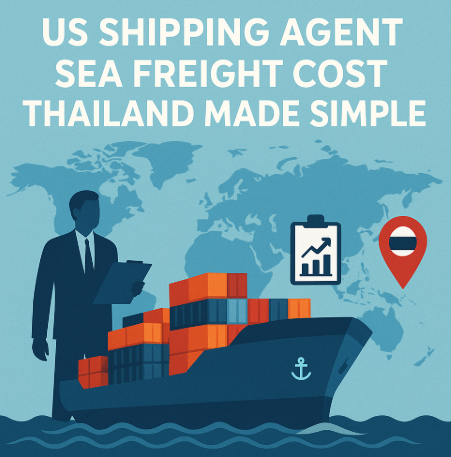
Managing sea freight shipments from Thailand to the United States can quickly become overwhelming, especially when businesses must juggle freight rates, customs requirements, container availability, and delivery schedules all at once. However, once you partner with a reliable us shipping agent sea freight cost Thailand service provider, the entire process—from PO creation to final delivery—becomes clearer, easier, and far more predictable. This guide explains how importers can reduce costs, maintain stable transit times, and simplify logistics without sacrificing speed or accuracy.
Because sea freight pricing and customs procedures vary widely, importers benefit greatly from an expert handling every detail with precision.

What Makes Sea Freight Cost Management Between Thailand and the US Challenging?
Many importers underestimate the volatility of sea freight pricing. Additionally, schedules fluctuate due to port congestion, carrier capacity, container shortages, and fuel adjustments. Therefore, companies often struggle to maintain predictable logistics budgets.
Common challenges include:
- Sudden freight rate increases during peak season
- Container shortages at Bangkok Port or Laem Chabang
- Longer transit times due to transshipment bottlenecks
- Complicated US customs documentation
- Hidden surcharges such as GRI, PSS, or EISF
- Delays caused by inaccurate HS codes
Moreover, many suppliers in Thailand provide incomplete export documents, which creates clearance risks. Thus, importers rely on shipping agents to prevent these delays and stabilize cost forecasting.
How Does a US Shipping Agent Help Reduce Sea Freight Costs From Thailand?
A qualified agent negotiates directly with carriers and consolidators to secure competitive rates. Furthermore, they optimize routing, container selection, and shipment timing to reduce unnecessary charges. Therefore, choosing the right logistics partner immediately improves overall cost control.
Key responsibilities include:
- Negotiating FCL and LCL ocean rates
- Choosing ports with better vessel frequency
- Consolidating multiple suppliers into one container
- Verifying export documents before container loading
- Coordinating customs clearance and ISF filing
- Tracking schedules and preventing demurrage
Because agents monitor pricing trends daily, they quickly identify the most affordable options while maintaining reliable transit time.
How Much Does Sea Freight from Thailand to the US Typically Cost?
Costs vary based on container type, destination port, and market conditions. However, the table below provides a clear benchmark to help compare options.
Estimated Sea Freight Cost Table
| Shipment Type | Route | Average Cost | Transit Time | Notes |
|---|---|---|---|---|
| 1×20GP | Bangkok → Los Angeles | USD 1250–1850 | 20–28 days | Cost varies with season |
| 1×40HQ | Laem Chabang → Long Beach | USD 1750–2600 | 22–30 days | Best cost per CBM |
| LCL (1–5 CBM) | Thailand → West Coast | USD 45–65/CBM | 26–34 days | Extra handling applies |
| LCL (6–12 CBM) | Thailand → East Coast | USD 60–85/CBM | 32–40 days | Longer transshipment |
Although rates fluctuate, working with a US shipping agent gives importers a clear advantage through negotiated pricing and strategic routing.
What Shipping Modes Are Best for Thailand–US Sea Freight?
Choosing the correct shipping mode directly impacts cost, speed, and operational simplicity. Consequently, comparing core options helps you make informed decisions.
Shipping Mode Comparison
| Mode | Best For | Pros | Cons |
|---|---|---|---|
| FCL | High-volume cargo | Lowest cost per CBM; secure | Requires full container load |
| LCL | Small shipments | Flexible volume; cost-effective | Longer handling and transit |
| FCL Premium | Higher-value goods | Faster loading & priority | Higher rate than standard FCL |
| Sea–Air Combo | Urgent + cost-sensitive cargo | Balanced cost/time | Requires more coordination |
Because each product category has different needs, importers should choose modes that match inventory cycles and budget goals.
How Does Customs Clearance Affect Sea Freight Costs?
Customs compliance plays a major role in determining final shipping expenses. Moreover, incorrect documentation often leads to holds, inspections, and storage fees.
Important customs factors include:
- HS code accuracy
- Origin certificate requirements
- ISF submission timing
- Packaging declarations
- APHIS/FDA regulations for certain goods
When documents match perfectly, clearance remains smooth and avoids costly delays. Therefore, an experienced agent ensures every detail meets US regulations.
What Documents Do Importers Need for Thailand–US Sea Freight?
Accurate documentation strengthens compliance and improves transit stability.
Customs Documentation Checklist
| Document | Required For | Details |
|---|---|---|
| Commercial Invoice | All cargo | Must include value, buyer, seller, terms |
| Packing List | All cargo | Details per carton and total CBM |
| Bill of Lading | Sea freight | Must match invoice details |
| Certificate of Origin | Certain goods | May reduce tariff rates |
| HS Code Declaration | All goods | Determines duty and customs category |
| ISF (10+2) | Sea shipments | Must be filed before departure |
With complete and correct documentation, clearance becomes much faster.
Why Is a US Shipping Agent Essential for Thailand–US Operations?
A professional agent improves every stage of the supply chain. Moreover, they eliminate the uncertainties importers usually face when handling multiple vendors on their own.
Core benefits include:
- Real-time tracking
- Transparent freight pricing
- Fewer mistakes in customs documentation
- Faster booking and container allocation
- Early visibility on sailing schedules
- Lower risk of storage charges
- Guidance on duty estimation and compliance
Because a reliable agent coordinates communication across Thailand, carriers, customs, and US trucking teams, the importer gains complete control and clarity.
Real Case Studies: Successful Thailand–US Sea Freight Operations
- Cargo: 1×40HQ wooden furniture
- Cost: USD 2,480
- Transit Time: 27 days
- Result: Consolidated at supplier warehouse, smooth clearance, no demurrage.
- Cargo: 12 CBM LCL
- Cost: USD 780
- Transit Time: 29 days
- Result: Seamless LCL handling, ISF filed early, quick pick-up at destination.
- Cargo: 1×20GP
- Cost: USD 1,620
- Transit Time: 34 days
- Result: Accurate documents prevented Customs exams, saving inspection fees.
How Should Importers Select the Right Sea Freight Partner in Thailand?
Before choosing a logistics partner, consider these essential criteria:
- Do they offer consistent rate visibility?
- Can they handle FCL and LCL efficiently?
- Do they provide US customs clearance support?
- Do they coordinate trucking to final destination?
- Do they offer 24/7 shipment visibility?
- Are they experienced with Thailand’s export process?
- Can they prevent demurrage or detention charges?
Since logistics performance impacts profit margins, selecting the right partner becomes a strategic advantage.
Conclusion
Choosing a reliable us shipping agent sea freight cost Thailand partner helps importers save money, stabilize transit schedules, and avoid customs-related delays. With expert coordination, clear documentation, and professional rate management, your shipments move more efficiently and predictably. Velotactlcs Logistics is ready to support your operations with dependable service and fully optimized sea freight solutions.
Need a quote?
Ready to get started? Contact us now to request a free shipping quote.
Frequently Asked Questions (FAQ)
Yes, rates fluctuate based on season, fuel cost, and carrier capacity.
FCL offers the lowest cost per CBM, while LCL is ideal for small shipments.
Absolutely. We handle ISF, documentation checks, and customs coordination.
Transit usually ranges from 20–34 days depending on the route and port.
Yes. We coordinate trucking, appointments, and container returns.